
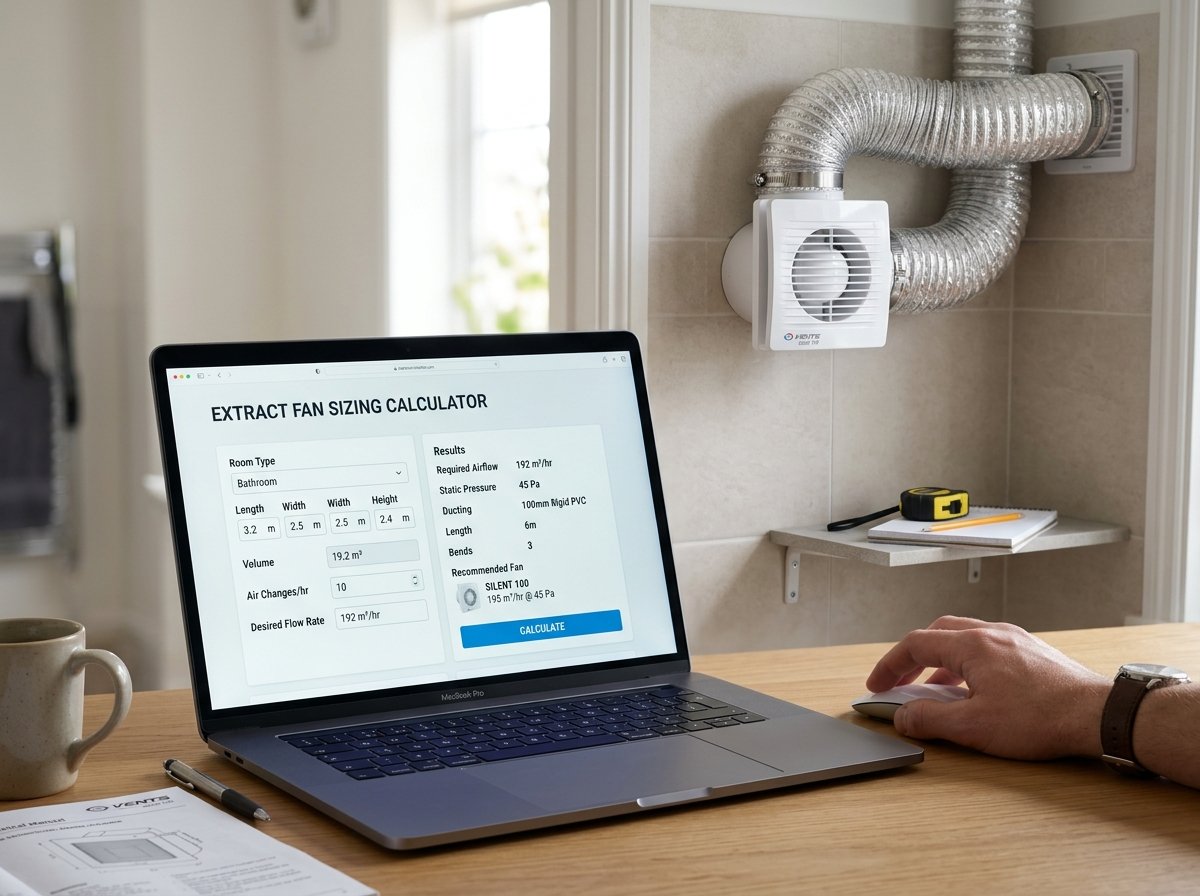
Extract Fan Sizing Calculator: Choose the Right Fan for Bathrooms, Kitchens, and More
Extract fans are essential for removing moisture, odours, and pollutants from bathrooms, kitchens, utility rooms, and other spaces. But choosing the wrong fan can lead to poor ventilation, excessive noise, or wasted energy. An undersized fan won’t clear steam and humidity effectively; an oversized fan wastes electricity and can be noisy. Our Extract Fan Sizing Calculator is a free online tool that helps you determine the correct airflow, design pressure, duct size, and total installed cost for your extract system.
In this guide, we’ll show you how to use the calculator, explain the calculations, provide real-world examples, and answer common questions. We’ll also share tips to ensure your extract fan design is efficient, quiet, and compliant with building regulations.
Extract Fan Sizing
Construction CalculatorExtract fan sizing: airflow, pressure, fan selection, ducting and cost.
What is the Extract Fan Sizing Calculator?
The Extract Fan Sizing Calculator is a free online tool that calculates the required airflow and pressure for an extract fan based on the room type, dimensions, duct run, and fan features. It supports common room types (bathroom, shower, WC, kitchen, utility, laundry, office, garage) and custom airflow. The calculator accounts for duct run resistance, duct type (rigid or flexible), fan type, features (timer, humidity sensor, PIR, smart, trickle boost), voltage (230 V or 12 V SELV), fan power, operating hours, electricity price, and local costs for the fan, ducting, accessories, and installation. It provides a clear breakdown of room volume, required airflow, design airflow (with margin), design pressure, duct velocity, minimum and recommended duct bore, annual energy consumption, annual running cost, and total installed cost. The tool is part of a suite of HVAC calculators available on our website. For related calculations, you can use our Duct Sizing Calculator, Duct Pressure Drop Calculator, Ventilation Airflow Calculator, and MVHR Sizing Calculator.
How to Use the Extract Fan Sizing Calculator
Using the calculator is straightforward. Here’s a breakdown of each field:
1. Room
- Room type: Select the room type: Bathroom, Shower room, WC / toilet, Kitchen (over hob), Kitchen (whole room), Utility room, Laundry, Office / meeting, Garage / workshop (6 ACH), or Custom airflow. This sets the default airflow requirement.
- Room length: Enter the length of the room in meters or feet.
- Room width: Enter the width of the room in meters or feet.
- Ceiling height: Enter the ceiling height in meters or feet.
- Custom airflow: If you selected “Custom airflow”, enter the required airflow in L/s.
2. Ducting
- Duct run type: Select the duct run resistance: Direct wall (< 1 m) — 30 Pa, Wall duct 1–3 m — 80 Pa, Ceiling duct 3–6 m — 150 Pa, Long duct 6–12 m — 220 Pa, or High resistance (multiple bends) — 300 Pa. These are preset pressures; you can override below.
- Duct length: Enter the duct length in meters or feet. Used for duct cost estimate.
- Bends / elbows: Enter the number of bends or elbows in the duct run.
- Duct diameter: Enter the duct diameter in meters or inches. Typically 100–150 mm.
- Duct type: Select Rigid duct or Flexible duct (+35% pressure). Rigid duct gives lower pressure loss.
3. Fan
- Fan type: Select Axial wall fan, Inline fan, Centrifugal fan, or Mixed-flow inline. Inline and mixed-flow fans overcome higher duct resistance.
- Design pressure override: If you know the design pressure, enter it here in Pa. Leave 0 to use the preset pressure for the selected duct run.
4. Features
- Features: Select Basic, Timer / run-on, Humidity sensor, PIR movement sensor, Smart / app controlled, or Trickle + boost. This affects fan cost only.
- Voltage: Select 12 V SELV (bathroom zone 1) or 230 V. Zone 1 bathroom requires SELV 12 V.
5. Running
- Fan power: Enter the fan power in watts from the datasheet.
- Operating hours per day: Enter the average operating hours per day. Trickle runs 24/7; boost runs a few hours per day.
- Electricity price per kWh: Enter your local tariff. Leave 0 to skip running cost.
6. Costs
- Fan price (base): Enter the local base price. Multipliers for fan type, features, and voltage apply on top.
- Duct cost per metre: Enter the local cost per metre.
- Accessories (grilles, kits): Enter the local total for grilles, backdraught shutter, and fixing kit.
- Installation: Enter the electrical and mechanical labour cost.
Once you enter all values, the calculator instantly displays:
- Room volume (m³)
- Required airflow (L/s)
- Design airflow (L/s and m³/h)
- Design pressure (Pa)
- Duct velocity (m/s)
- Minimum duct bore (mm)
- Recommended duct bore (mm)
- Bends / elbows
- Fan power (W)
- Annual energy (kWh)
- Annual running cost (if electricity price entered)
- Fan cost, ducting cost, accessories, installation, and total installed cost
Understanding the Cost Components
To make the most of the calculator, it’s important to understand each output and the underlying logic.
- Room volume:
length × width × height. Used for garage ventilation (6 air changes per hour) and for reference. - Required airflow: Based on room type. Standard values: bathroom 15 L/s, shower 15 L/s, WC 6 L/s, kitchen over hob 60 L/s, kitchen whole room 30 L/s, utility 30 L/s, laundry 30 L/s, office 12 L/s. For garage, 6 ACH is converted to L/s:
6 × volume / 3.6. For custom, the value you enter is used. - Design airflow: Required airflow multiplied by 1.15 (15% margin for duct leakage and design reserve).
- Design pressure: The resistance the fan must overcome. Presets are based on duct run type: direct wall 30 Pa, wall duct 80 Pa, ceiling duct 150 Pa, long duct 220 Pa, high resistance 300 Pa. If flexible duct is selected, the preset is multiplied by 1.35. If you enter a pressure override > 0, that value is used instead.
- Duct velocity:
design airflow (m³/s) / duct area. High velocity causes noise and pressure drop. Recommended velocity for extract ducts is 3–5 m/s. - Minimum duct bore: The diameter required for 4 m/s velocity, calculated as
√(Q / π)where Q is design airflow in m³/s. - Recommended duct bore: The smallest standard size (80, 100, 125, 150, 160, 200, 250 mm) that is at least the minimum bore. If none, the largest standard size is used.
- Annual energy:
fan power (W) / 1000 × hours per day × 365. - Annual running cost:
annual energy × electricity price per kWh. - Fan cost: Base price multiplied by fan type, feature, and voltage multipliers. For example, an inline fan (1.00) with humidity sensor (1.20) at 230 V (1.00) gives 1.20 × base price.
- Duct cost:
duct length × cost per metre. No pressure multiplier applied. - Total installed cost: Fan cost + duct cost + accessories + installation.
Understanding these components helps you interpret the results and adjust your design. For more information on extract ventilation, you can refer to Wikipedia’s article on ventilation.
Example Calculations
Let’s run through a few examples to see how the calculator works in different scenarios.
Example 1: Bathroom, 2.5 m × 2.0 m × 2.4 m, Wall Duct 2 m, Humidity Sensor
- Room type: Bathroom (15 L/s)
- Room volume: 2.5 × 2.0 × 2.4 = 12 m³
- Duct run: Wall duct 1–3 m (80 Pa)
- Duct length: 2 m
- Bends: 2
- Duct diameter: 0.100 m (100 mm)
- Duct type: Rigid
- Fan type: Inline
- Features: Humidity sensor
- Voltage: 230 V
- Fan power: 25 W
- Hours per day: 3
- Electricity price: $0.20/kWh
- Fan price: $80
- Duct cost per metre: $8
- Accessories: $25
- Installation: $120
Calculations:
- Required airflow: 15 L/s
- Design airflow: 15 × 1.15 = 17.25 L/s; in m³/h = 17.25 × 3.6 = 62.1 m³/h
- Design pressure: 80 Pa (rigid)
- Duct area: π × (0.05)² = 0.007854 m²
- Q = 17.25 / 1000 = 0.01725 m³/s
- Velocity = 0.01725 / 0.007854 = 2.20 m/s
- Minimum duct bore for 4 m/s: d = √(Q / π) = √(0.01725 / 3.1416) = √0.00549 = 0.0741 m = 74.1 mm
- Recommended standard bore: smallest ≥ 74.1 is 80 mm
- Annual energy: (25/1000) × 3 × 365 = 27.375 kWh
- Annual cost: 27.375 × $0.20 = $5.48
- Fan cost: base $80 × inline 1.00 × humidity 1.20 × 230V 1.00 = $96
- Duct cost: 2 × $8 = $16
- Total installed: $96 + $16 + $25 + $120 = $257
- Result: Design airflow 17.25 L/s, pressure 80 Pa, duct 80 mm, total $257
Example 2: Kitchen Over Hob, 4 m × 3 m × 2.4 m, Long Duct 8 m, Flexible, Centrifugal
- Room type: Kitchen (over hob) — 60 L/s
- Room volume: 4 × 3 × 2.4 = 28.8 m³
- Duct run: Long duct 6–12 m (220 Pa)
- Duct length: 8 m
- Bends: 3
- Duct diameter: 0.150 m (150 mm)
- Duct type: Flexible (+35% pressure)
- Fan type: Centrifugal
- Features: Timer
- Voltage: 230 V
- Fan power: 60 W
- Hours per day: 4
- Electricity price: $0.25/kWh
- Fan price: $150
- Duct cost per metre: $12
- Accessories: $40
- Installation: $200
Calculations:
- Required airflow: 60 L/s
- Design airflow: 60 × 1.15 = 69 L/s; m³/h = 248.4
- Design pressure: 220 × 1.35 = 297 Pa
- Q = 69 / 1000 = 0.069 m³/s
- Area = π × (0.075)² = 0.01767 m²
- Velocity = 0.069 / 0.01767 = 3.90 m/s
- Min bore for 4 m/s: √(0.069 / π) = √0.02196 = 0.1482 m = 148.2 mm
- Recommended standard: 150 mm
- Annual energy: (60/1000) × 4 × 365 = 87.6 kWh
- Annual cost: 87.6 × $0.25 = $21.90
- Fan cost: base $150 × centrifugal 1.40 × timer 0.90 × 230V 1.00 = $189
- Duct cost: 8 × $12 = $96
- Total installed: $189 + $96 + $40 + $200 = $525
- Result: Design airflow 69 L/s, pressure 297 Pa, duct 150 mm, total $525
Example 3: Garage/Workshop, 6 m × 4 m × 2.8 m, Direct Wall, Axial
- Room type: Garage / workshop (6 ACH)
- Room volume: 6 × 4 × 2.8 = 67.2 m³
- Required airflow: 6 × 67.2 / 3.6 = 112 L/s
- Duct run: Direct wall (< 1 m) — 30 Pa
- Duct length: 0.5 m
- Bends: 0
- Duct diameter: 0.200 m (200 mm)
- Duct type: Rigid
- Fan type: Axial wall
- Features: Basic
- Voltage: 230 V
- Fan power: 40 W
- Hours per day: 2
- Electricity price: $0.15/kWh
- Fan price: $120
- Duct cost per metre: $10
- Accessories: $15
- Installation: $100
Calculations:
- Required airflow: 112 L/s
- Design airflow: 112 × 1.15 = 128.8 L/s; m³/h = 463.7
- Design pressure: 30 Pa (rigid)
- Q = 128.8 / 1000 = 0.1288 m³/s
- Area = π × (0.100)² = 0.03142 m²
- Velocity = 0.1288 / 0.03142 = 4.10 m/s
- Min bore for 4 m/s: √(0.1288 / π) = √0.04099 = 0.2025 m = 202.5 mm
- Recommended standard: 250 mm (since 200 < 202.5, next is 250)
- Annual energy: (40/1000) × 2 × 365 = 29.2 kWh
- Annual cost: 29.2 × $0.15 = $4.38
- Fan cost: base $120 × axial 0.80 × basic 0.70 × 230V 1.00 = $67.20
- Duct cost: 0.5 × $10 = $5
- Total installed: $67.20 + $5 + $15 + $100 = $187.20
- Result: Design airflow 128.8 L/s, pressure 30 Pa, duct 250 mm, total $187.20
These examples show how different room types, duct runs, and fan options affect the required airflow, pressure, and total cost.
Benefits of Using the Extract Fan Sizing Calculator
Tips for Accurate Extract Fan Sizing
- Determine the required airflow correctly: Use building regulations or standard values. Bathrooms typically need 15 L/s, kitchens 60 L/s over the hob or 30 L/s for the whole room. Garages may need 6 air changes per hour.
- Account for duct resistance: Long ducts, bends, and flexible ducting increase pressure drop. Use the presets or override with a calculated value.
- Choose the right fan type: Axial wall fans are suitable for short, direct duct runs. Inline and centrifugal fans are better for longer runs or higher resistance.
- Select appropriate features: Humidity sensors are ideal for bathrooms; timers for WCs; PIR for utility rooms. Smart controls offer scheduling and app control.
- Consider voltage: In bathroom Zone 1, 12 V SELV is required. Elsewhere, 230 V is standard.
- Check duct velocity: Keep velocity between 3 and 5 m/s to minimize noise. Higher velocities cause whistling and increased pressure drop.
- Size duct properly: The recommended duct bore ensures velocity is reasonable. Use the Duct Sizing Calculator for precise sizing.
- Include a margin: The calculator adds 15% to required airflow. This covers leakage and ensures the fan isn’t running at its limit.
- Estimate running costs: Fan power and operating hours determine energy use. Choose an efficient fan to reduce long-term costs.
- Verify with a professional: For complex systems or commercial kitchens, have a qualified engineer verify the design.
For more information on extract ventilation, you can refer to resources like Wikipedia’s article on ventilation or guidelines from the Building Regulations.
How to Reduce Extract Fan Costs
If your estimate is higher than expected, here are ways to reduce costs without compromising performance:
- Choose a simpler fan type: Axial wall fans are cheaper than centrifugal fans. Use them for short, direct duct runs.
- Minimize duct length and bends: Shorter, straighter runs reduce pressure and allow a smaller, cheaper fan.
- Use rigid duct: Flexible duct increases pressure and may require a more powerful fan. Rigid duct is often cheaper over the long run.
- Select only necessary features: Basic fans are cheapest. Add only the features you need (e.g., humidity sensor for bathrooms).
- Install yourself: If you’re competent, DIY installation saves labour costs. However, electrical work should be done by a qualified electrician.
- Buy in bulk: For multiple fans, ask for a trade discount.
- Compare prices: Get quotes from several suppliers.
Frequently Asked Questions (FAQ)
Conclusion
The Extract Fan Sizing Calculator is an essential tool for homeowners, builders, and HVAC professionals. It helps you determine the correct airflow, pressure, duct size, and total cost for extract fans in bathrooms, kitchens, utility rooms, and more. By following the tips in this article and using the calculator, you can confidently specify an efficient and compliant extract system. Don’t forget to explore our other HVAC calculators for all your ventilation needs.
Whether you’re installing a single bathroom fan or designing a whole-house ventilation system, accurate extract fan sizing is key to a healthy and comfortable indoor environment. Try the Extract Fan Sizing Calculator today and take the guesswork out of your ventilation design.





One Comment