
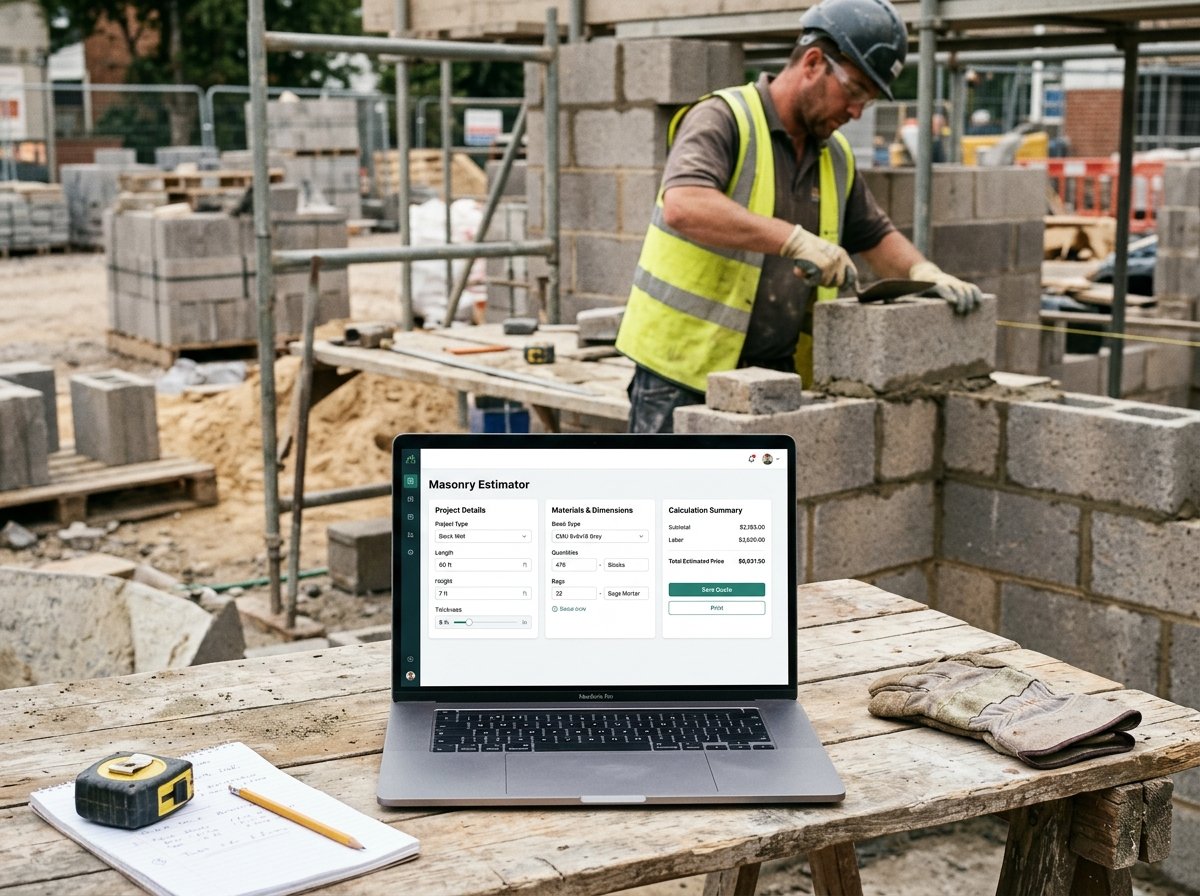
Masonry Quote Calculator: Estimate Brick and Block Work Costs Accurately
Masonry—brick and block work—is one of the most visible and fundamental trades in construction. From garden walls and extensions to full building envelopes, the quality and cost of masonry work have a major impact on the project. Whether you’re a bricklayer preparing a quote or a homeowner budgeting for a wall, accurate cost estimation is essential. An underestimated quote can lead to lost profits or unfinished work; an overestimated quote can lose you the job. Our Masonry Quote Calculator is a free online tool that helps you quickly estimate the total cost of masonry works, including blocks, mortar, reinforcement, labour, scaffolding, and contingency. It provides a clear breakdown so you can present a professional quote or plan your project with confidence.
In this guide, we’ll show you how to use the calculator, explain each cost component, provide real-world examples, and answer common questions. We’ll also share tips to ensure your masonry estimate is accurate and competitive.
Masonry Quote
Construction CalculatorMasonry works quote: blocks, mortar, reinforcement, labour and scaffolding.
What is the Masonry Quote Calculator?
The Masonry Quote Calculator is a free online tool that calculates the material and labour costs for brick, block, cinder block, AAC block, and stone masonry. It accounts for gross wall area, openings, actual wall thickness, reference thickness for quoted rates, material price per m², mortar volume and price, reinforcement (mesh), labour rate per m², scaffolding area and price, and a contingency percentage. It provides a clear breakdown of net masonry area, material cost, mortar volume and cost, reinforcement cost, scaffolding cost, bricklaying labour, contingency, and grand total. The tool is part of a suite of cost and finance calculators available on our website. For related estimates, you can use our Concrete Quote Calculator, Roof Repair Cost Calculator, Deck Cost Calculator, and Door Installation Cost Calculator.
How to Use the Masonry Quote Calculator
Using the calculator is straightforward. Here’s a breakdown of each field:
1. Dimensions
- Masonry area: Enter the gross wall area in square meters or square feet, before deducting openings.
- Openings area: Enter the total area of windows and doors in square meters or square feet. This is deducted from the gross area to give the net masonry area.
- Actual wall thickness: Enter the actual thickness of the wall in meters or inches. For example, 0.25 m = 250 mm.
- Reference thickness for quoted rates: Enter the thickness that your material, mortar, and labour rates refer to. For example, if your rates are for a 250 mm wall, enter 0.25 m. The calculator uses the ratio of actual thickness to reference thickness to scale costs appropriately.
2. Material
- Masonry material: Select the material: Brick, Block (clay / AAC), Cinder block, AAC block, or Stone. This is for reference; enter the material price for the selected type below.
- Material price per m² of wall: Enter the local price per square meter of wall at the reference thickness.
3. Mortar
- Mortar per m²: Enter the mortar volume per square meter of wall at the reference thickness. Usually 0.02–0.04 m³/m².
- Mortar price per m³: Enter the local price per cubic meter of mortar.
4. Reinforcement
- Mesh per m² of wall: Enter the mesh area per square meter of wall. If reinforced every other course, usually 1.0. Set to 0 to skip.
- Mesh price per m²: Enter the local price per square meter of mesh.
5. Labour
- Labour rate per m²: Enter the bricklayer rate per square meter for the selected material at the reference thickness.
6. Scaffolding
- Scaffolding area: Enter the scaffolding area in square meters or square feet. Needed if wall height > 3 m. Set to 0 if not required.
- Scaffolding price per m²: Enter the local scaffolding rate per square meter.
7. Costs
- Contingency: Enter a percentage for unforeseen costs. Typically 3–8% for masonry works. The default is 5%.
Once you enter all values, the calculator instantly displays:
- Net masonry area (m²)
- Masonry material cost
- Mortar volume (m³)
- Mortar cost
- Reinforcement cost (if mesh entered)
- Scaffolding cost (if entered)
- Bricklaying labour cost
- Contingency amount
- Grand total
Understanding the Cost Components
To make the most of the calculator, it’s important to understand each output and the underlying formulas.
- Net masonry area:
gross area − openings area. This is the actual area of wall to be built. - Thickness ratio (th_k):
actual thickness / reference thickness. This scales material, mortar, and labour costs when the actual wall thickness differs from the thickness on which your rates are based. For example, if your rates are for a 100 mm wall but you’re building a 200 mm wall, th_k = 2.0, and material, mortar, and labour costs double. The ratio is capped at a minimum of 0.1 to prevent unreasonable scaling. - Material cost:
net area × material price per m² × th_k. You buy more material for thicker walls. - Mortar volume:
net area × mortar per m² × th_k. Thicker walls require more mortar. - Mortar cost:
mortar volume × mortar price per m³. - Mesh area:
net area × mesh per m². If mesh is laid every other course, the mesh per m² is typically 1.0 (meaning 1 m² of mesh per m² of wall). If mesh is laid every course, it would be 2.0. The calculator lets you specify. - Mesh cost:
mesh area × mesh price per m². - Scaffolding cost:
scaffolding area × scaffolding price per m². Scaffolding is typically required for walls over 3 m high. - Labour cost:
net area × labour rate per m² × th_k. Thicker walls take longer to build, so labour scales with thickness. - Subtotal: Sum of material, mortar, mesh, scaffolding, and labour.
- Contingency:
subtotal × contingency percentage / 100. This covers unexpected issues like damaged blocks, additional mortar, or minor design changes. - Grand total: Subtotal + contingency. This is the total quote amount.
Understanding these components helps you adjust your rates and present a transparent quote. For more information on masonry construction, you can refer to Wikipedia’s article on masonry.
Example Calculations
Let’s run through a few examples to see how the calculator works in different scenarios.
Example 1: Block Wall, 40 m² Gross, 5 m² Openings, 250 mm Thick
- Masonry area: 40 m²
- Openings area: 5 m²
- Actual wall thickness: 0.25 m
- Reference thickness: 0.25 m
- Masonry material: Block
- Material price: $45/m²
- Mortar per m²: 0.03 m³/m²
- Mortar price: $120/m³
- Mesh per m²: 0 (no reinforcement)
- Mesh price: $0
- Labour rate: $50/m²
- Scaffolding area: 0 m²
- Scaffolding price: $0
- Contingency: 5%
Calculations:
- Net area = 40 − 5 = 35 m²
- Thickness ratio = 0.25 / 0.25 = 1.0
- Material cost = 35 × $45 × 1.0 = $1,575
- Mortar volume = 35 × 0.03 × 1.0 = 1.05 m³
- Mortar cost = 1.05 × $120 = $126
- Mesh cost = $0
- Scaffolding cost = $0
- Labour cost = 35 × $50 × 1.0 = $1,750
- Subtotal = $1,575 + $126 + $1,750 = $3,451
- Contingency = 5% of $3,451 = $172.55
- Total = $3,451 + $172.55 = $3,623.55
- Result: Grand total $3,623.55
Example 2: Brick Wall, 80 m² Gross, 10 m² Openings, 200 mm Thick, Mesh Reinforcement
- Masonry area: 80 m²
- Openings area: 10 m²
- Actual wall thickness: 0.20 m
- Reference thickness: 0.25 m
- Masonry material: Brick
- Material price: $60/m²
- Mortar per m²: 0.035 m³/m²
- Mortar price: $130/m³
- Mesh per m²: 1.0
- Mesh price: $4/m²
- Labour rate: $65/m²
- Scaffolding area: 40 m²
- Scaffolding price: $15/m²
- Contingency: 8%
Calculations:
- Net area = 80 − 10 = 70 m²
- Thickness ratio = 0.20 / 0.25 = 0.80
- Material cost = 70 × $60 × 0.80 = $3,360
- Mortar volume = 70 × 0.035 × 0.80 = 1.96 m³
- Mortar cost = 1.96 × $130 = $254.80
- Mesh area = 70 × 1.0 = 70 m²
- Mesh cost = 70 × $4 = $280
- Scaffolding cost = 40 × $15 = $600
- Labour cost = 70 × $65 × 0.80 = $3,640
- Subtotal = $3,360 + $254.80 + $280 + $600 + $3,640 = $8,134.80
- Contingency = 8% of $8,134.80 = $650.78
- Total = $8,134.80 + $650.78 = $8,785.58
- Result: Grand total $8,785.58
Example 3: Stone Wall, 30 m² Gross, 3 m² Openings, 300 mm Thick, Scaffolding
- Masonry area: 30 m²
- Openings area: 3 m²
- Actual wall thickness: 0.30 m
- Reference thickness: 0.25 m
- Masonry material: Stone
- Material price: $90/m²
- Mortar per m²: 0.04 m³/m²
- Mortar price: $140/m³
- Mesh per m²: 0
- Mesh price: $0
- Labour rate: $80/m²
- Scaffolding area: 20 m²
- Scaffolding price: $18/m²
- Contingency: 6%
Calculations:
- Net area = 30 − 3 = 27 m²
- Thickness ratio = 0.30 / 0.25 = 1.20
- Material cost = 27 × $90 × 1.20 = $2,916
- Mortar volume = 27 × 0.04 × 1.20 = 1.296 m³
- Mortar cost = 1.296 × $140 = $181.44
- Mesh cost = $0
- Scaffolding cost = 20 × $18 = $360
- Labour cost = 27 × $80 × 1.20 = $2,592
- Subtotal = $2,916 + $181.44 + $360 + $2,592 = $6,049.44
- Contingency = 6% of $6,049.44 = $362.97
- Total = $6,049.44 + $362.97 = $6,412.41
- Result: Grand total $6,412.41
These examples show how different wall areas, thicknesses, and materials affect the total cost.
Benefits of Using the Masonry Quote Calculator
Tips for Accurate Masonry Quote Estimation
- Measure the wall area accurately: For simple rectangular walls, multiply length by height. For walls with gables or irregular shapes, divide into triangles and rectangles, calculate each area, and sum.
- Deduct openings correctly: Subtract the area of windows and doors to get the net masonry area. This is the area you actually build.
- Enter the correct reference thickness: Your material, mortar, and labour rates are probably quoted for a specific thickness (e.g., 100 mm, 250 mm). Enter that as the reference thickness. The calculator scales costs if the actual thickness differs.
- Choose the right material: Brick, block, cinder block, AAC block, and stone have different costs and labour requirements. Enter the correct price per m² for your chosen material.
- Estimate mortar volume realistically: Mortar consumption depends on block size and joint thickness. Typical values are 0.02–0.04 m³/m². Check with your supplier if unsure.
- Consider reinforcement: If the wall requires mesh reinforcement (e.g., for movement joints or structural reasons), enter the mesh per m² and price. If not required, set to 0.
- Include scaffolding: Walls over 3 m high typically require scaffolding. Enter the scaffolding area (usually the wall area) and the local rate per m².
- Use realistic labour rates: Bricklaying rates vary by region and material. Brick is more labour-intensive than block; stone is even more so. Adjust the rate accordingly.
- Add contingency: 5% is typical, but increase to 8–10% for complex designs, restoration work, or uncertain site conditions.
- Verify with a professional: For structural masonry, have a qualified engineer verify the design and quantities.
For more information on masonry estimating, you can refer to resources like Wikipedia’s article on masonry or guidelines from the Brick Development Association.
How to Reduce Masonry Costs
If your estimate is higher than expected, here are ways to reduce costs without compromising quality:
- Choose a cheaper material: Block is generally cheaper than brick. AAC block is lightweight and quick to install. Cinder block is economical for internal walls.
- Optimize wall thickness: Work with your engineer to minimize thickness while meeting structural and thermal requirements.
- Reduce openings: Fewer openings mean less cutting and less waste. However, this is a design decision.
- Use larger blocks: Larger blocks cover more area per unit, reducing mortar and labour time.
- Buy in bulk: Negotiate discounts for large orders of blocks, bricks, and mortar.
- Do some preparation yourself: If you’re competent, you can set out the wall, mix mortar, and prepare the site, leaving the skilled bricklaying to a professional.
- Get multiple quotes: Compare suppliers and bricklayers for the best price. But never choose solely on price—quality matters.
- Phase the work: If budget is tight, build the most important walls first and add secondary walls later.
Frequently Asked Questions (FAQ)
Conclusion
The Masonry Quote Calculator is an essential tool for bricklayers, builders, and homeowners. It helps you estimate the total cost of brick and block work, including materials, mortar, reinforcement, labour, scaffolding, and contingency. By following the tips in this article and using the calculator, you can confidently prepare quotes and budgets. Don’t forget to explore our other cost and finance calculators for all your construction needs.
Whether you’re building a garden wall or a full house extension, accurate masonry estimation is key to a successful project. Try the Masonry Quote Calculator today and take the guesswork out of your masonry budget.

3 Comments