
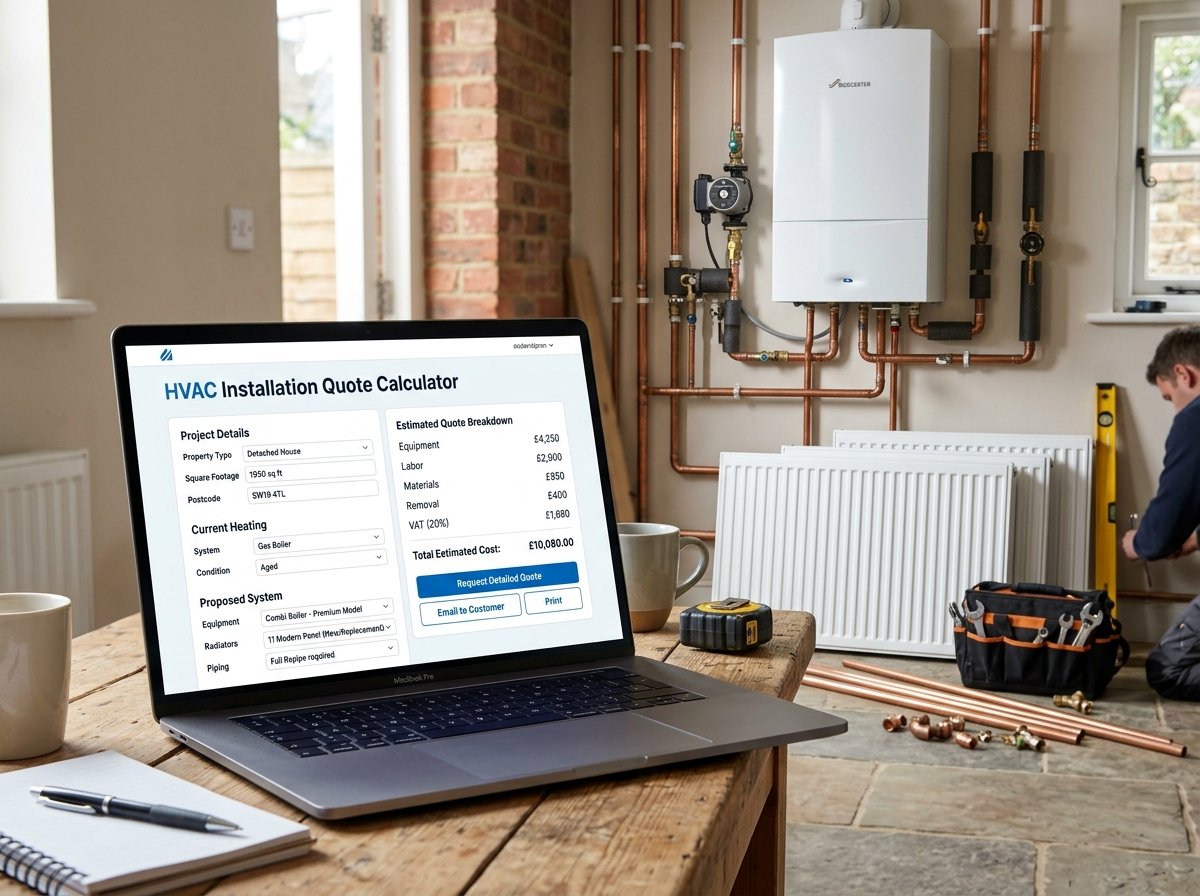
HVAC Installation Quote Calculator: Estimate Heating and Cooling Costs Accurately
Heating, ventilation, and air conditioning (HVAC) systems are the heart of a comfortable home or commercial building. Whether you’re installing a new boiler, upgrading to a heat pump, or fitting underfloor heating, getting the costs right is essential. An underestimated quote can lead to financial loss; an overestimated quote can lose you the job. Our HVAC Installation Quote Calculator is a free online tool that helps you quickly estimate the total cost of an HVAC installation, including main equipment, radiators, pipes, consumables, labour, and contingency. It provides a clear breakdown so you can present a professional quote or plan your project with confidence.
In this guide, we’ll show you how to use the calculator, explain each cost component, provide real-world examples, and answer common questions. We’ll also share tips to ensure your HVAC estimate is accurate and competitive.
HVAC Installation Quote
Construction CalculatorHVAC install quote: boiler/heat pump, radiators, pipes, labour and consumables.
What is the HVAC Installation Quote Calculator?
The HVAC Installation Quote Calculator is a free online tool that calculates the material and labour costs for heating, ventilation, and air conditioning installations. It supports several system types (boiler + radiators, underfloor heating, heat pump, hybrid) and equipment classes (budget, standard, premium). The calculator accounts for heated area, number of rooms, boiler or heat pump price, radiator count and price, pipe length and price, consumables, installation labour rate per m², and a contingency percentage. It provides a clear breakdown of main equipment cost, radiator count and cost, pipe cost, consumables cost, labour cost, contingency, and grand total. The tool is part of a suite of cost and finance calculators available on our website. For related estimates, you can use our Electrical Quote Calculator, Plumbing Quote Calculator, Masonry Quote Calculator, and Concrete Quote Calculator.
How to Use the HVAC Installation Quote Calculator
Using the calculator is straightforward. Here’s a breakdown of each field:
1. System
- System type: Select the type of HVAC system: Boiler + radiators, Underfloor heating, Heat pump, or Hybrid. This is for reference; enter equipment and labour prices for your selected system below.
- Heated area: Enter the total heated area in square meters or square feet.
- Number of rooms: Enter the number of rooms. This is used as a fallback for radiator count if the radiators field is left at 0.
2. Equipment
- Equipment class: Select Budget, Standard, or Premium. This is for reference; enter the price for your chosen class below.
- Boiler / heat pump price: Enter the main equipment cost—the boiler, heat pump, or underfloor heating manifold and controls.
3. Radiators
- Radiator count: Enter the number of radiators or heating zones. Set to 0 to auto-fill from the number of rooms.
- Radiator price incl. install: Enter the local price per radiator, including material and installation.
4. Pipes
- Pipe length: Enter the total length of pipe required in meters or feet.
- Pipe price per metre: Enter the local price per metre of pipe.
- Consumables / fittings: Enter the total cost of fittings, valves, sealants, and other consumables.
5. Labour
- Installation rate per m²: Enter the local labour rate for the heated area. This covers the installation of the system, including pipework and radiator mounting.
6. Costs
- Contingency: Enter a percentage for unforeseen costs. Typically 5–15% for HVAC works. The default is 10%.
Once you enter all values, the calculator instantly displays:
- Main equipment cost
- Radiator count and cost
- Pipe cost
- Consumables cost
- Installation labour cost
- Contingency amount
- Grand total
Understanding the Cost Components
To make the most of the calculator, it’s important to understand each output and the underlying formulas.
- Main equipment cost: The price you enter for the boiler, heat pump, or underfloor heating manifold. This is often the single largest cost.
- Radiator count: If you enter a number greater than 0, that number is used. If you enter 0 and the number of rooms is greater than 0, the calculator uses the number of rooms as the radiator count. This assumes one radiator per room on average.
- Radiator cost:
radiator count × radiator price incl. install. This includes both the radiator itself and the labour to install it. If you prefer to separate material and labour, adjust the radiator price and reduce the labour rate per m² accordingly. - Pipe cost:
pipe length × pipe price per metre. Pipework is a significant material cost, especially for larger properties. - Consumables cost: The total you enter for fittings, valves, sealants, and other small items. This is a fixed cost.
- Labour cost:
heated area × installation rate per m². This is the labour to install the system, excluding radiator installation if that is included in the radiator price. Adjust the rate to reflect the scope of work. - Subtotal: Sum of equipment, radiators, pipes, consumables, and labour.
- Contingency:
subtotal × contingency percentage / 100. This covers unexpected issues like additional pipework, flue modifications, or electrical connections. - Grand total: Subtotal + contingency. This is the total quote amount.
Understanding these components helps you adjust your rates and present a transparent quote. For more information on HVAC systems, you can refer to Wikipedia’s article on HVAC.
Example Calculations
Let’s run through a few examples to see how the calculator works in different scenarios.
Example 1: Boiler + Radiators, 120 m², 6 Rooms, Standard Equipment
- System type: Boiler + radiators
- Heated area: 120 m²
- Number of rooms: 6
- Equipment class: Standard
- Boiler price: $2,500
- Radiator count: 8
- Radiator price incl. install: $300 each
- Pipe length: 80 m
- Pipe price: $8/m
- Consumables: $400
- Labour rate per m²: $25/m²
- Contingency: 10%
Calculations:
- Main equipment cost = $2,500
- Radiator count = 8 (entered)
- Radiator cost = 8 × $300 = $2,400
- Pipe cost = 80 × $8 = $640
- Consumables cost = $400
- Labour cost = 120 × $25 = $3,000
- Subtotal = $2,500 + $2,400 + $640 + $400 + $3,000 = $8,940
- Contingency = 10% of $8,940 = $894
- Total = $8,940 + $894 = $9,834
- Result: Grand total $9,834
Example 2: Heat Pump, 180 m², 8 Rooms, Premium Equipment
- System type: Heat pump
- Heated area: 180 m²
- Number of rooms: 8
- Equipment class: Premium
- Heat pump price: $6,000
- Radiator count: 0 (will fall back to 8 rooms)
- Radiator price incl. install: $350 each
- Pipe length: 120 m
- Pipe price: $10/m
- Consumables: $600
- Labour rate per m²: $30/m²
- Contingency: 12%
Calculations:
- Main equipment cost = $6,000
- Radiator count = 8 (from rooms)
- Radiator cost = 8 × $350 = $2,800
- Pipe cost = 120 × $10 = $1,200
- Consumables cost = $600
- Labour cost = 180 × $30 = $5,400
- Subtotal = $6,000 + $2,800 + $1,200 + $600 + $5,400 = $16,000
- Contingency = 12% of $16,000 = $1,920
- Total = $16,000 + $1,920 = $17,920
- Result: Grand total $17,920
Example 3: Underfloor Heating, 80 m², 4 Rooms, Budget Equipment
- System type: Underfloor heating
- Heated area: 80 m²
- Number of rooms: 4
- Equipment class: Budget
- Manifold and controls price: $1,200
- Radiator count: 0 (falls back to 4 zones)
- Radiator price incl. install: $200 per zone (actuator and thermostat)
- Pipe length: 400 m
- Pipe price: $2/m
- Consumables: $300
- Labour rate per m²: $20/m²
- Contingency: 8%
Calculations:
- Main equipment cost = $1,200
- Zone count = 4
- Zone cost = 4 × $200 = $800
- Pipe cost = 400 × $2 = $800
- Consumables cost = $300
- Labour cost = 80 × $20 = $1,600
- Subtotal = $1,200 + $800 + $800 + $300 + $1,600 = $4,700
- Contingency = 8% of $4,700 = $376
- Total = $4,700 + $376 = $5,076
- Result: Grand total $5,076
These examples show how different system types, areas, and equipment classes affect the total cost.
Benefits of Using the HVAC Installation Quote Calculator
Tips for Accurate HVAC Quote Estimation
- Determine the correct system type: Boilers are common in older homes; heat pumps are more efficient but require good insulation. Underfloor heating is comfortable but slower to respond. Choose the system that best suits the building and client.
- Size the equipment correctly: The boiler or heat pump must be sized to the heat loss of the building. Undersized equipment won’t heat the space; oversized equipment wastes energy. Use a heat loss calculator or consult a professional.
- Count radiators accurately: The number of radiators depends on room sizes and heat loss. One radiator per room is a rough average. For large rooms, you may need two. Adjust the count accordingly.
- Estimate pipe length realistically: Pipe runs are rarely straight. Add 10–20% for slack, routing around obstacles, and vertical drops. The calculator uses the length you enter, so you can include waste in your estimate.
- Choose the right pipe size: Different systems require different pipe sizes. Boiler systems typically use 15–22 mm copper or plastic; underfloor heating uses 16–20 mm. Enter the correct price per metre.
- Account for consumables: Fittings, valves, sealants, flue parts, and controls add up. Enter a realistic total.
- Use realistic labour rates: Labour rates vary by region and system complexity. Boiler installations take 2–3 days; heat pump installations can take 3–5 days. Underfloor heating is more labour-intensive. Adjust the rate per m² accordingly.
- Add contingency: 10% is a good starting point. Increase to 15% for older buildings or complex installations.
- Consider electrical work: HVAC systems often require electrical connections. If not included in the labour rate, add an electrical allowance.
- Verify with a professional: For complex systems or commercial projects, have a qualified HVAC engineer verify the design and quantities.
For more information on HVAC design and installation, you can refer to resources like Wikipedia’s article on HVAC or guidelines from the Chartered Institution of Building Services Engineers.
How to Reduce HVAC Installation Costs
If your estimate is higher than expected, here are ways to reduce costs without compromising comfort or efficiency:
- Choose a standard equipment class: Budget or standard boilers are cheaper than premium models. However, consider long-term efficiency and warranty.
- Optimize radiator count: If some rooms are small or well-insulated, you may need fewer radiators. But ensure the heat output meets the room’s demand.
- Reduce pipe runs: Shorter pipe runs save material and labour. Design the system layout to minimise pipe length.
- Use plastic pipe instead of copper: Plastic pipe is cheaper and easier to install. Copper is more durable but more expensive.
- Do some preparation yourself: If you’re competent, you can remove old systems, lift floorboards, or chase walls. However, gas and electrical work must be done by qualified professionals.
- Buy equipment directly: Some contractors mark up equipment. Buying directly can save money, but ensure compatibility and warranty.
- Get multiple quotes: Compare HVAC contractors for the best price. But never choose solely on price—quality and certification matter.
- Phase the work: If budget is tight, install the main system first and add radiators or zones later.
Frequently Asked Questions (FAQ)
Conclusion
The HVAC Installation Quote Calculator is an essential tool for heating engineers, contractors, and homeowners. It helps you estimate the total cost of an HVAC installation, including equipment, radiators, pipes, consumables, labour, and contingency. By following the tips in this article and using the calculator, you can confidently prepare quotes and budgets. Don’t forget to explore our other cost and finance calculators for all your construction needs.
Whether you’re installing a new boiler or upgrading to a heat pump, accurate HVAC estimation is key to a successful project. Try the HVAC Installation Quote Calculator today and take the guesswork out of your heating budget.


One Comment