
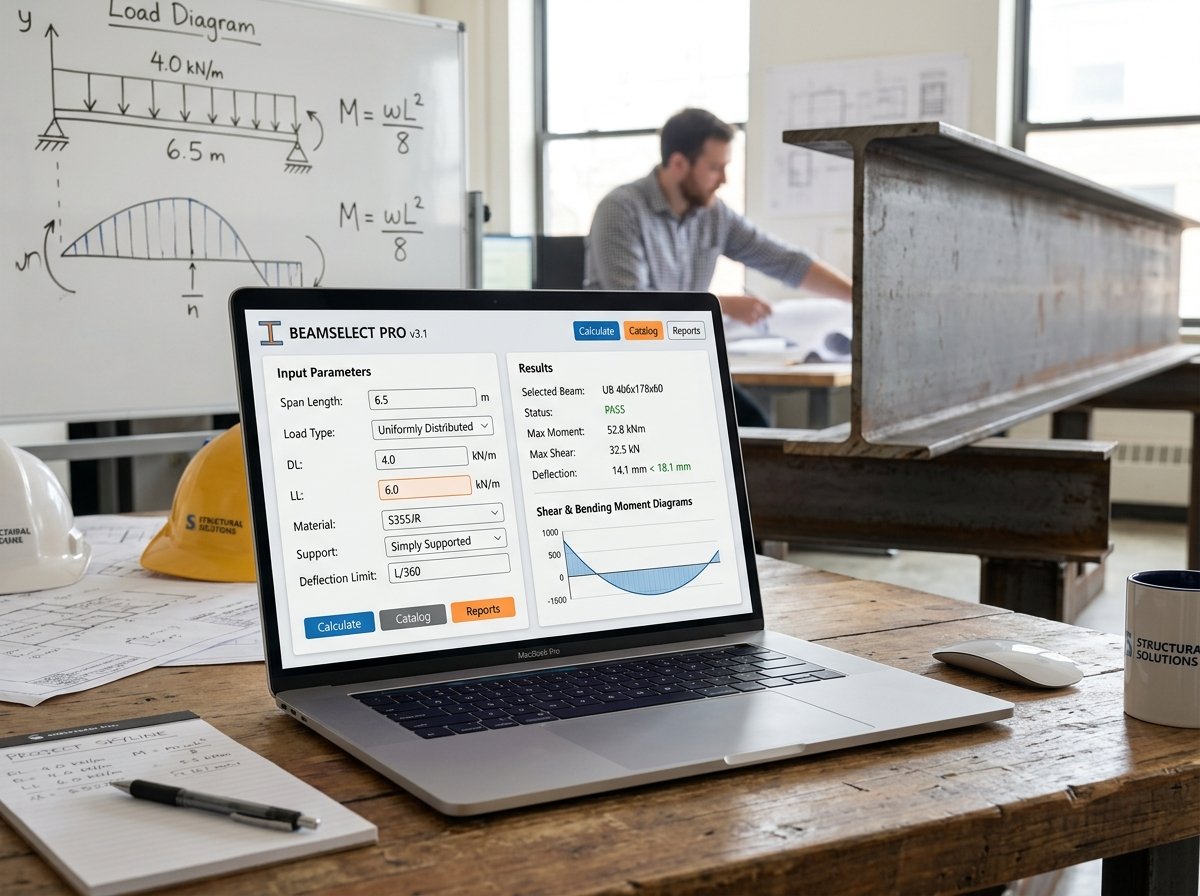
Steel Beam (UB) Selection Calculator: Choose the Right Universal Beam
Steel beams are the backbone of many structural frames, from house extensions to industrial buildings. Selecting the correct Universal Beam (UB) is critical for safety, serviceability, and cost. An undersized beam may deflect excessively or even fail; an oversized beam wastes steel and money. Our Steel Beam (UB) Selection Calculator is a free online tool that helps you determine the required section modulus, choose the lightest suitable UB from a standard table, and estimate deflection and costs.
In this guide, we’ll show you how to use the calculator, explain the calculations, provide real-world examples, and answer common questions. We’ll also share tips to ensure your steel beam design is accurate and efficient.
Steel Beam (UB) Selection
Construction CalculatorUniversal beam selection: required Z, recommended UB, mass, deflection, cost.
What is the Steel Beam (UB) Selection Calculator?
The Steel Beam (UB) Selection Calculator is a free online tool that selects the smallest standard UK Universal Beam (UB) that satisfies both bending strength and deflection limits for a given span, support condition, load, and steel grade. It supports simply supported, cantilever, and fixed-end beams under uniformly distributed loads (UDL) or point loads (mid-span or at a specified distance for simply supported beams). The calculator provides a clear breakdown of maximum bending moment, shear force, required section modulus, recommended UB section, steel mass, actual deflection, deflection limit, and costs including steel, fabrication, fire protection, installation, and crane hire. The tool is part of a suite of structural calculators available on our website. For related calculations, you can use our Beam Bending Moment Calculator, Column Axial Load Calculator, Floor Joist Sizing Calculator, and Lintel Sizing Calculator.
How to Use the Steel Beam (UB) Selection Calculator
Using the calculator is straightforward. Here’s a breakdown of each field:
1. Beam
- Clear span: Enter the clear distance between supports in meters or feet. For cantilevers, enter the length of the cantilever.
- Support: Select the support condition: Simply supported, Cantilever, or Fixed both ends.
2. Load
- Load type: Select the load type: UDL (kN/m), Point load at mid-span, or Point load at distance (simply supported only).
- Load: Enter the load value. For UDL, enter the load per metre in kN/m. For a point load, enter the total load in kN.
- Point-load position: If you selected “Point load at distance”, enter the distance from the left support in meters or feet. This field is ignored for other load types.
3. Steel
- Steel grade: Select S275 (fy = 275 N/mm²) or S355 (fy = 355 N/mm²).
- Deflection limit: Enter the deflection limit as a divisor of the span. For example, 360 gives L/360. Typical values: L/360 for domestic floors, L/240 for roofs.
4. Fire protection
- Fire protection: Select No protection, Fire board, or Intumescent paint. This affects cost only; beam selection is unchanged.
- Fire protection per metre: Enter the local cost per metre for fire protection. Leave 0 to skip.
5. Costs
- Steel price per kg: Enter the fabricated and delivered price per kg of steel. Leave 0 to skip.
- Fabrication: Enter the cost for cutting, drilling, and end plates.
- Installation: Enter the installation cost.
- Crane / hire: Enter the crane or hire cost. Set to 0 if not required.
Once you enter all values, the calculator instantly displays:
- Max moment (kN·m)
- Max shear (kN)
- Required Z (cm³)
- Recommended UB
- Steel mass (kg)
- Deflection (mm)
- Deflection limit (mm)
- Steel cost, fabrication, fire protection, crane, installation, and grand total (if costs entered)
Understanding the Cost Components
To make the most of the calculator, it’s important to understand each output and the underlying formulas.
- Max moment (M): The maximum bending moment in the beam, calculated from the support and load type. For a simply supported beam with UDL:
M = wL²/8. For a cantilever with UDL:M = wL²/2. For a fixed-end beam with UDL:M = wL²/12. For point loads, similar formulas apply. - Max shear (V): The maximum shear force, also dependent on support and load.
- Required section modulus (Z_req): The minimum section modulus needed to resist the moment without exceeding the yield strength:
Z_req = M / fy. It is expressed in cm³. - Recommended UB: The smallest standard Universal Beam from a built-in table whose section modulus
Zis at leastZ_reqand whose deflection under the design load is within the specified limit. The table includes common UK UB sections with theirZ(cm³),I(cm⁴), and mass (kg/m). - Deflection: The maximum vertical displacement of the beam, calculated using the appropriate formula for the support and load type:
- Simply supported, UDL:
δ = 5wL⁴ / (384EI) - Cantilever, UDL:
δ = wL⁴ / (8EI) - Fixed, UDL:
δ = wL⁴ / (384EI) - Simply supported, point at mid-span:
δ = PL³ / (48EI) - Cantilever, point at free end:
δ = PL³ / (3EI) - Fixed, point at mid-span:
δ = PL³ / (192EI) - Simply supported, point at distance a:
δ = P a² b² / (3EI L)
- Simply supported, UDL:
- Deflection limit:
L / n, where n is the divisor you enter (e.g., 360). - Steel mass:
kg/m × span. Used for cost calculation. - Costs: Steel cost (mass × price per kg), fabrication, fire protection (span × cost per metre × multiplier), crane, and installation. The grand total is the sum.
Understanding these components helps you interpret the results and adjust your design. For more information on steel beam design, you can refer to Wikipedia’s article on I-beams.
Example Calculations
Let’s run through a few examples to see how the calculator works in different scenarios.
Example 1: Simply Supported Beam, UDL, 4 m Span
- Clear span: 4 m
- Support: Simply supported
- Load type: UDL
- Load: 30 kN/m
- Steel grade: S275 (fy = 275 N/mm²)
- Deflection limit: L/360
- Fire protection: No
- Costs: Steel price $2/kg, fabrication $100, installation $150, crane $0
Calculations:
- Max moment: M = 30 × 4² / 8 = 60 kN·m = 60,000,000 N·mm
- Required Z: 60,000,000 / 275 / 1000 = 218.2 cm³
- Deflection limit: 4000 / 360 = 11.11 mm
- Check UB table:
- 203×102×23: Z=200 cm³ (<218.2) – fail bending.
- 203×133×25: Z=258 cm³ (≥218.2), I=2890 cm⁴. Deflection = 5 × 30 × 4000⁴ / (384 × 210000 × 2890×10⁴) = let’s compute: 5×30=150; 4000⁴=2.56e14; numerator=3.84e16; denominator=384×210000×2.89e7=384×6.069e12=2.33e15; deflection=16.48 mm (>11.11) – fail deflection.
- 254×102×22: Z=262, I=2850. Deflection = 3.84e16 / (384×210000×2.85e7) = 3.84e16 / 2.298e15 = 16.71 mm – fail.
- 254×102×25: Z=306, I=3410. Deflection = 3.84e16 / (384×210000×3.41e7) = 3.84e16 / 2.75e15 = 13.96 mm – fail.
- 254×146×31: Z=405, I=5540. Deflection = 3.84e16 / (384×210000×5.54e7) = 3.84e16 / 4.47e15 = 8.59 mm (≤11.11). Pass. Z=405 ≥218.2.
- Recommended: 254×146×31 UB
- Steel mass: 31 × 4 = 124 kg
- Steel cost: 124 × $2 = $248
- Total: $248 + $100 + $150 = $498
- Result: 254×146×31 UB, deflection 8.59 mm, total $498
Example 2: Cantilever, Point Load at Free End, 2 m
- Clear span: 2 m
- Support: Cantilever
- Load type: Point load at mid-span (but for cantilever, point load is always taken at free end; the calculator treats “point” as at free end)
- Load: 15 kN
- Steel grade: S355 (fy = 355 N/mm²)
- Deflection limit: L/240
- Fire protection: Fire board at $20/m
- Costs: Steel price $2.5/kg, fabrication $80, installation $120, crane $200
Calculations:
- Max moment: M = 15 × 2 = 30 kN·m = 30,000,000 N·mm
- Required Z: 30,000,000 / 355 / 1000 = 84.5 cm³
- Deflection limit: 2000 / 240 = 8.33 mm
- Check UB table:
- 152×89×16: Z=89 (≥84.5), I=834 cm⁴. Deflection = 15000 × 2000³ / (3 × 210000 × 834×10⁴) = 15000×8e9 / (3×210000×8.34e6) = 1.2e14 / 5.254e12 = 22.84 mm (>8.33) – fail.
- 178×102×19: Z=135, I=1360. Deflection = 1.2e14 / (3×210000×1.36e7) = 1.2e14 / 8.568e12 = 14.0 mm – fail.
- 203×102×23: Z=200, I=2100. Deflection = 1.2e14 / (3×210000×2.1e7) = 1.2e14 / 1.323e13 = 9.07 mm – fail (>8.33).
- 203×133×25: Z=258, I=2890. Deflection = 1.2e14 / (3×210000×2.89e7) = 1.2e14 / 1.821e13 = 6.59 mm (≤8.33). Pass. Z=258 ≥84.5.
- Recommended: 203×133×25 UB
- Steel mass: 25 × 2 = 50 kg
- Steel cost: 50 × $2.5 = $125
- Fire protection cost: span × cost/m × multiplier = 2 × $20 × 1.0 = $40
- Total: $125 + $80 + $120 + $200 + $40 = $565
- Result: 203×133×25 UB, deflection 6.59 mm, total $565
Example 3: Fixed Both Ends, UDL, 6 m Span
- Clear span: 6 m
- Support: Fixed both ends
- Load type: UDL
- Load: 20 kN/m
- Steel grade: S275 (fy = 275 N/mm²)
- Deflection limit: L/360
- Fire protection: Intumescent paint at $30/m
- Costs: Steel price $2/kg, fabrication $150, installation $200, crane $300
Calculations:
- Max moment: M = 20 × 6² / 12 = 60 kN·m = 60,000,000 N·mm
- Required Z: 60,000,000 / 275 / 1000 = 218.2 cm³
- Deflection limit: 6000 / 360 = 16.67 mm
- Check UB table:
- 203×133×25: Z=258, I=2890. Deflection = w L⁴ / (384 E I) = 20 × 6000⁴ / (384 × 210000 × 2890×10⁴) = 20×1.296e15 / (384×210000×2.89e7) = 2.592e16 / 2.33e15 = 11.12 mm (≤16.67). Pass. Z=258 ≥218.2.
- Recommended: 203×133×25 UB
- Steel mass: 25 × 6 = 150 kg
- Steel cost: 150 × $2 = $300
- Fire protection cost: 6 × $30 × 1.8 = $324
- Total: $300 + $150 + $200 + $300 + $324 = $1,274
- Result: 203×133×25 UB, deflection 11.12 mm, total $1,274
These examples show how different supports, loads, and grades affect the required UB size and cost.
Benefits of Using the Steel Beam (UB) Selection Calculator
Tips for Accurate Steel Beam Selection
- Use the correct support condition: Simply supported, cantilever, and fixed ends have very different moment and deflection formulas. Selecting the wrong support will give incorrect results.
- Enter the correct load type and value: For UDL, enter the load per metre (kN/m). For point loads, enter the total load (kN). Ensure the point-load position is correct for “point_e”.
- Choose the right steel grade: S275 is common; S355 is stronger and may allow a lighter section. Compare costs.
- Set a realistic deflection limit: L/360 is standard for domestic floors. L/240 is acceptable for roofs. L/480 for sensitive finishes.
- Check fire protection requirements: Fire protection adds cost but does not change the beam size. Include it in your budget.
- Account for self-weight: The calculator does not add the beam’s self-weight to the load. For long spans, add an allowance (e.g., 1–2 kN/m) to the UDL or point load.
- Consider lateral restraint: The calculator assumes the beam is laterally restrained. Unrestrained beams may have lower bending capacity due to lateral-torsional buckling. Consult a structural engineer.
- Verify with a professional: For any structural work, have a qualified engineer verify your calculations and ensure compliance with local building codes.
For more information on steel beam design, you can refer to resources like Wikipedia’s article on structural steel or guidelines from the Steel Construction Institute.
How to Reduce Steel Beam Costs
If your calculated beam size is larger than desired, here are ways to reduce costs without compromising safety:
- Reduce the span: Adding an intermediate support can shorten the span, reducing the required section.
- Reduce the load: If possible, reduce the loads on the beam (e.g., use lighter floor materials).
- Use a higher steel grade: S355 may allow a lighter section than S275. Compare material and fabrication costs.
- Optimize the deflection limit: If a less stringent limit is acceptable, a smaller beam may suffice. Check local codes.
- Consider a different section shape: In some cases, a cellular beam or a plate girder may be more efficient, but they are usually more expensive to fabricate.
- Get multiple quotes: Compare steel suppliers and fabricators for the best price.
Frequently Asked Questions (FAQ)
Conclusion
The Steel Beam (UB) Selection Calculator is an essential tool for builders, architects, engineers, and DIY enthusiasts. It helps you determine the correct Universal Beam size for your project, ensuring safety and serviceability without over-engineering. By following the tips in this article and using the calculator, you can confidently select your steel beam. Don’t forget to explore our other structural calculators for all your design needs.
Whether you’re building an extension or designing a commercial frame, accurate steel beam selection is key to a successful project. Try the Steel Beam (UB) Selection Calculator today and take the guesswork out of your structural design.



One Comment