Solar Panel Output Calculator: Estimate Generation, Savings, and Payback
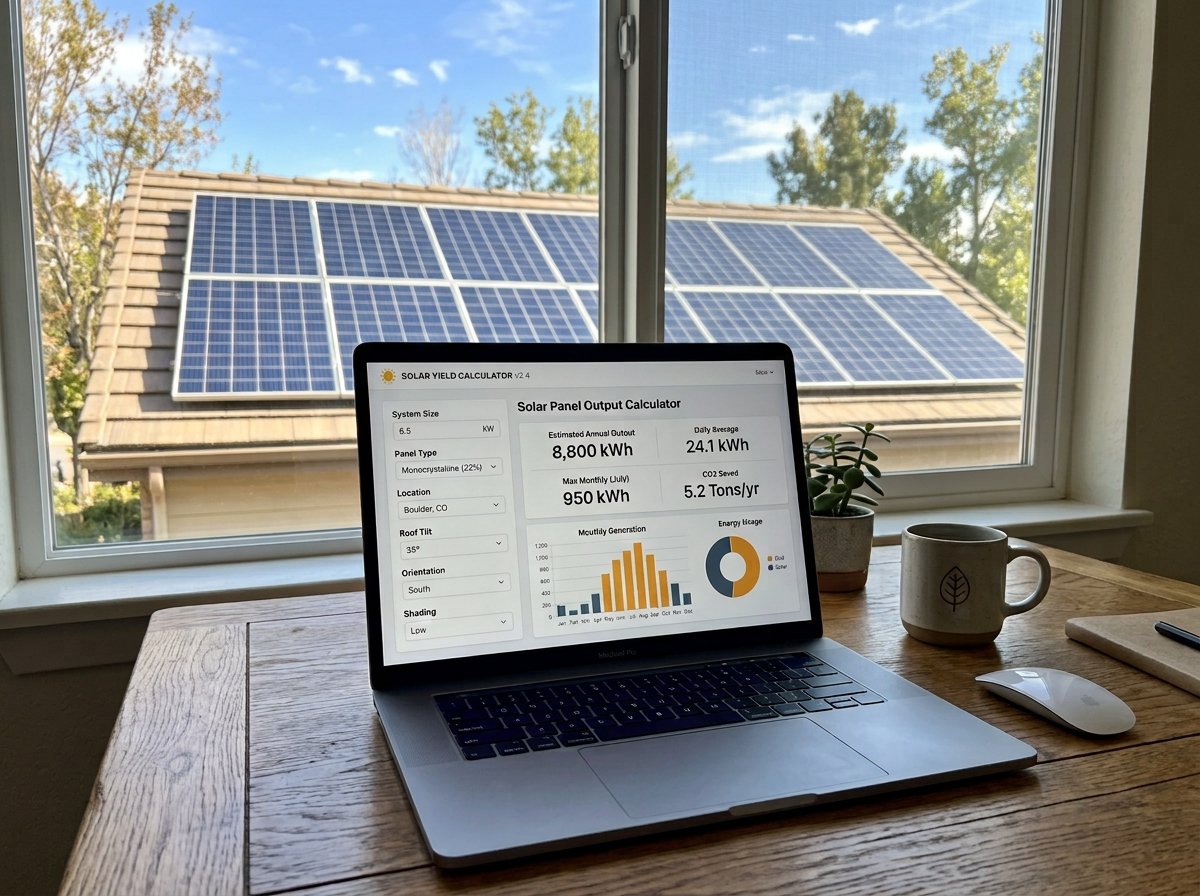
Solar panels are a smart investment for many homes and businesses, but their financial and environmental benefits depend on several factors: system size, location, orientation, electricity prices, and how much of the generated power you actually use. Our Solar Panel Output Calculator is a free online tool that helps you estimate annual generation, self-consumption, export income, payback period, and CO₂ savings. Whether you’re considering a small rooftop system or a larger commercial array, this calculator gives you a clear picture of what to expect.
In this guide, we’ll show you how to use the calculator, explain the calculations, provide real-world examples, and answer common questions. We’ll also share tips to maximize your solar investment.
Solar Panel Output
Construction CalculatorSolar PV output and payback: annual generation, self-consumption, savings and CO₂ avoided.
What is the Solar Panel Output Calculator?
The Solar Panel Output Calculator is a free online tool that estimates the annual energy generation of a solar PV system and its financial performance. It accounts for system size (kWp), specific yield (kWh/kWp/yr), performance ratio, household annual consumption, self-consumption ratio, import and export prices, and installed cost. It provides a detailed breakdown of annual generation, self-consumed energy, exported energy, grid import required, savings on imports, export income, annual benefit, net grid cost, simple payback, 25-year net benefit, and CO₂ avoided. The calculator is part of a suite of electrical and energy calculators available on our website. For related calculations, you can use our Backup Generator Sizing Calculator, kW ↔ kVA Converter Calculator, Appliance Running Cost Calculator, and Lighting Fixture Count Calculator.
How to Use the Solar Panel Output Calculator
Using the calculator is straightforward. Here’s a breakdown of each field:
1. System
- System size (kWp): Enter the peak DC capacity of your solar array in kilowatts-peak (kWp). This is the sum of the panel ratings under standard test conditions. For example, 10 panels of 400 W each give a 4 kWp system.
- Specific yield (kWh/kWp/yr): Enter the expected annual energy yield per kWp of installed capacity. This depends on your location, orientation, tilt, and shading. Typical values range from 800 to 1800 kWh/kWp/yr. If you’re unsure, check a solar map or consult an installer. A common value for moderate climates is 1200.
- Performance ratio (%): Enter the performance ratio, which accounts for real-world losses such as inverter efficiency, wiring losses, soiling, and temperature. Typical values are 75–85%. The default is 80%.
2. Consumption
- Household annual use (kWh): Enter your total annual electricity consumption in kilowatt-hours. You can find this on your utility bill. If you don’t have it, estimate by adding up the usage of your appliances.
- Self-consumption ratio (%): Enter the share of your solar generation that you use on site. The rest is exported to the grid. Without battery storage, typical self-consumption is 30–60%. With a battery, it can be 70–90%. The default is 40%.
3. Pricing
- Import price: Enter the price you pay the grid per kWh. This is your electricity tariff. Check your utility bill.
- Export / feed-in price: Enter the price the grid pays you per kWh exported. If your utility does not offer a feed-in tariff, set this to 0.
- Installed cost: Enter the total turnkey cost of your solar system before any subsidies or tax credits. This includes panels, inverter, mounting, wiring, and installation labour.
Once you enter all values, the calculator instantly displays:
- Annual generation (kWh)
- Self-consumed (kWh)
- Exported to grid (kWh)
- Grid import required (kWh)
- Savings on imports
- Export income
- Annual benefit
- Grid cost without PV
- Net grid cost with PV
- Simple payback (years)
- 25-year net benefit
- CO₂ avoided per year (kg)
Understanding the Cost Components
To make the most of the calculator, it’s important to understand each component and how it affects your solar investment.
- Annual generation: The total energy your system produces in a year. It’s calculated as
kWp × specific yield × (performance ratio / 100). For example, a 4 kWp system with 1200 kWh/kWp/yr and 80% performance ratio generates 4 × 1200 × 0.8 = 3,840 kWh per year. - Self-consumed: The portion of generation used directly on site. It’s calculated as
generation × self-consumption ratio / 100. However, it cannot exceed your annual household use. If it does, the excess is added to exports. - Exported to grid: The portion of generation not self-consumed. It’s
generation − self-consumedplus any excess self-consumption that exceeded annual use. - Grid import required: The electricity you still need to buy from the grid:
max(0, annual use − self-consumed). - Savings on imports: The money you save by not buying that electricity from the grid:
self-consumed × import price. - Export income: The money you earn from exporting excess electricity:
exported × export price. - Annual benefit: The sum of savings on imports and export income.
- Grid cost without PV: What you would pay for electricity without solar:
annual use × import price. - Net grid cost with PV: Your remaining electricity bill after solar:
grid import required × import price − export income. This can be negative if export income exceeds your import cost. - Simple payback: How many years it takes for the annual benefit to cover the installed cost:
installed cost / annual benefit. - 25-year net benefit: The total financial benefit over 25 years minus the installed cost:
annual benefit × 25 − installed cost. This is a simplified metric that ignores inflation, degradation, and maintenance. - CO₂ avoided: The annual reduction in carbon emissions, calculated as
generation × 0.40 kg CO₂/kWh. The 0.40 factor is a typical grid-average emission factor; your local grid may be cleaner or dirtier.
Understanding these components helps you evaluate the financial and environmental return of a solar investment. For more information on solar PV, you can refer to Wikipedia’s article on solar power.
Example Calculations
Let’s run through a few examples to see how the calculator works in different scenarios.
Example 1: 4 kWp Home System, Moderate Climate
- System size: 4 kWp
- Specific yield: 1200 kWh/kWp/yr
- Performance ratio: 80%
- Annual use: 3500 kWh
- Self-consumption: 40%
- Import price: $0.20/kWh
- Export price: $0.05/kWh
- Installed cost: $6,000
Calculations:
- Annual generation: 4 × 1200 × 0.80 = 3,840 kWh
- Self-consumed: 3,840 × 40% = 1,536 kWh (less than 3,500, so no cap)
- Exported: 3,840 − 1,536 = 2,304 kWh
- Grid import: 3,500 − 1,536 = 1,964 kWh
- Savings on imports: 1,536 × $0.20 = $307.20
- Export income: 2,304 × $0.05 = $115.20
- Annual benefit: $307.20 + $115.20 = $422.40
- Grid cost without PV: 3,500 × $0.20 = $700
- Net grid cost with PV: 1,964 × $0.20 − $115.20 = $392.80 − $115.20 = $277.60
- Payback: $6,000 / $422.40 = 14.2 years
- 25-year net benefit: $422.40 × 25 − $6,000 = $10,560 − $6,000 = $4,560
- CO₂ avoided: 3,840 × 0.40 = 1,536 kg
- Result: 3,840 kWh generated, $422 annual benefit, 14.2-year payback
Example 2: 10 kWp Commercial System, High Yield
- System size: 10 kWp
- Specific yield: 1600 kWh/kWp/yr
- Performance ratio: 82%
- Annual use: 8,000 kWh
- Self-consumption: 50%
- Import price: $0.25/kWh
- Export price: $0.10/kWh
- Installed cost: $15,000
Calculations:
- Annual generation: 10 × 1600 × 0.82 = 13,120 kWh
- Self-consumed: 13,120 × 50% = 6,560 kWh (less than 8,000, so no cap)
- Exported: 13,120 − 6,560 = 6,560 kWh
- Grid import: 8,000 − 6,560 = 1,440 kWh
- Savings on imports: 6,560 × $0.25 = $1,640
- Export income: 6,560 × $0.10 = $656
- Annual benefit: $1,640 + $656 = $2,296
- Grid cost without PV: 8,000 × $0.25 = $2,000
- Net grid cost with PV: 1,440 × $0.25 − $656 = $360 − $656 = −$296 (you get paid)
- Payback: $15,000 / $2,296 = 6.5 years
- 25-year net benefit: $2,296 × 25 − $15,000 = $57,400 − $15,000 = $42,400
- CO₂ avoided: 13,120 × 0.40 = 5,248 kg
- Result: 13,120 kWh generated, $2,296 annual benefit, 6.5-year payback
Example 3: Small System with Battery, High Self-Consumption
- System size: 3 kWp
- Specific yield: 1000 kWh/kWp/yr
- Performance ratio: 78%
- Annual use: 2500 kWh
- Self-consumption: 80%
- Import price: $0.30/kWh
- Export price: $0.00/kWh
- Installed cost: $7,000
Calculations:
- Annual generation: 3 × 1000 × 0.78 = 2,340 kWh
- Self-consumed: 2,340 × 80% = 1,872 kWh (less than 2,500, so no cap)
- Exported: 2,340 − 1,872 = 468 kWh
- Grid import: 2,500 − 1,872 = 628 kWh
- Savings on imports: 1,872 × $0.30 = $561.60
- Export income: 468 × $0.00 = $0
- Annual benefit: $561.60
- Grid cost without PV: 2,500 × $0.30 = $750
- Net grid cost with PV: 628 × $0.30 − $0 = $188.40
- Payback: $7,000 / $561.60 = 12.5 years
- 25-year net benefit: $561.60 × 25 − $7,000 = $14,040 − $7,000 = $7,040
- CO₂ avoided: 2,340 × 0.40 = 936 kg
- Result: 2,340 kWh generated, $561.60 annual benefit, 12.5-year payback
These examples show how location, system size, self-consumption, and pricing affect the financial return.
Benefits of Using the Solar Panel Output Calculator
Tips for Accurate Solar Output Estimation
- Use a realistic specific yield: This is the most important input. It depends on your location, roof orientation, tilt, and shading. Use online solar maps or consult an installer for a site-specific estimate.
- Don’t overestimate performance ratio: Real-world losses are inevitable. A performance ratio of 80% is typical; 85% is optimistic for most installations.
- Know your consumption: Check your utility bill for annual kWh. If you don’t have a full year, estimate from monthly bills.
- Be realistic about self-consumption: Without a battery, you can only use solar when the sun is shining and you have demand. A typical home uses 30–50% of its solar generation on site. With a battery, self-consumption can reach 70–90%.
- Check feed-in tariffs: Export prices vary widely. Some utilities pay retail rate, others pay a lower avoided cost, and some pay nothing. Enter the correct value.
- Include all costs: The installed cost should include panels, inverter, mounting, wiring, labour, permits, and any necessary grid connection upgrades.
- Consider degradation: Solar panels degrade about 0.5–0.8% per year. The 25-year net benefit in the calculator does not account for this, so actual returns may be slightly lower.
- Account for maintenance: Solar systems require occasional cleaning and inverter replacement (around year 10–15). Add these costs if you want a more precise financial analysis.
- Check local incentives: Many regions offer tax credits, rebates, or grants. Subtract these from the installed cost for a more accurate payback.
For more information on solar economics, you can refer to resources like Wikipedia’s article on solar energy or guidelines from the International Energy Agency.
How to Maximize Your Solar Savings
If you want to improve the financial performance of your solar system, here are practical strategies:
- Increase self-consumption: Shift heavy loads (washing machine, dishwasher, EV charging) to daytime hours when solar is generating. This reduces export and increases savings at the retail rate.
- Add battery storage: A battery stores excess solar for evening use, boosting self-consumption and reducing grid import. It also provides backup power.
- Optimize orientation and tilt: In the northern hemisphere, south-facing panels at a tilt equal to your latitude generally yield the most energy. East-west orientations produce less but spread generation over the day.
- Avoid shading: Even partial shading can significantly reduce output. Trim trees or relocate panels if possible.
- Keep panels clean: Dust, pollen, and bird droppings reduce output. Regular cleaning maintains performance.
- Choose a reputable installer: Quality installation ensures optimal performance and safety. Get multiple quotes and check reviews.
- Monitor performance: Use a monitoring app to track generation and detect issues early. Underperformance may indicate a fault.
Frequently Asked Questions (FAQ)
Conclusion
The Solar Panel Output Calculator is an essential tool for anyone considering solar PV. It helps you estimate generation, savings, payback, and environmental benefits, so you can make an informed decision. By following the tips in this article and using the calculator, you can confidently plan your solar investment. Don’t forget to explore our other electrical and energy calculators for all your engineering needs.
Whether you’re installing a small rooftop system or a large commercial array, accurate output estimation is key to a successful project. Try the Solar Panel Output Calculator today and take the guesswork out of your solar budget.