
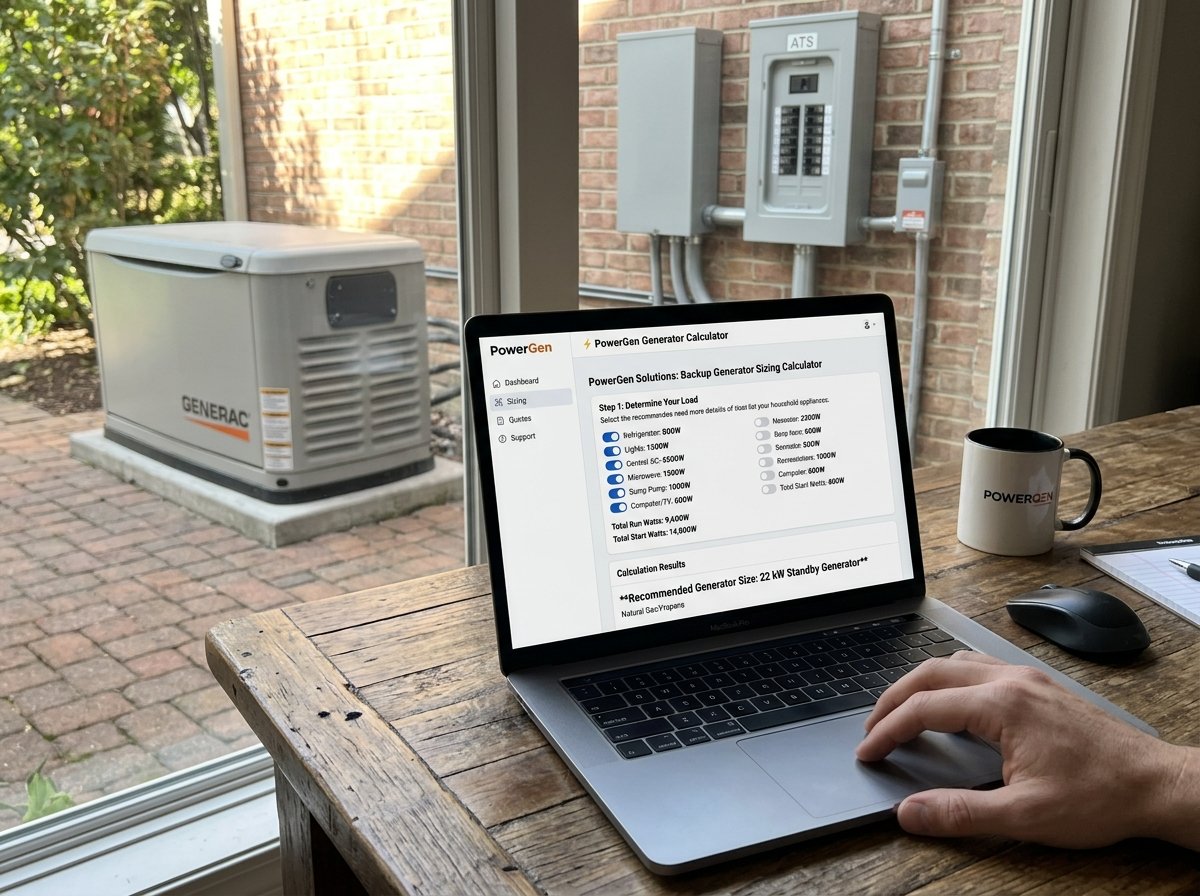
Backup Generator Sizing Calculator: Choose the Right Generator Accurately
A backup generator is an essential investment for homes and businesses that cannot afford downtime. Whether you’re protecting against grid outages, powering a remote site, or providing emergency backup for critical systems, choosing the right generator size is crucial. An undersized generator will trip, overheat, or fail to start large loads. An oversized generator wastes fuel, costs more, and may run inefficiently. Our Backup Generator Sizing Calculator is a free online tool that helps you determine the running load, starting surge, required kVA, and the recommended generator size for your needs.
In this guide, we’ll show you how to use the calculator, explain the calculations, provide real-world examples, and answer common questions. We’ll also share tips to ensure your generator is sized correctly for reliability and efficiency.
Backup Generator Sizing
Construction CalculatorBackup generator sizing: running load, starting surge, recommended kVA.
What is the Backup Generator Sizing Calculator?
The Backup Generator Sizing Calculator is a free online tool that calculates the required generator capacity based on your base running load, largest motor, motor starting factor, HVAC or other surge loads, power factor, and desired reserve capacity. It provides a clear breakdown of running load, starting surge, design load with reserve, running kVA, surge kVA, required kVA, and the recommended standard generator size. The calculator is part of a suite of electrical and engineering calculators available on our website. For related calculations, you can use our Cable Size (Single-Phase) Calculator, Cable Size (Three-Phase) Calculator, Circuit Breaker Sizing Calculator, and kW ↔ kVA Converter Calculator.
How to Use the Backup Generator Sizing Calculator
Using the calculator is straightforward. Here’s a breakdown of each field:
1. Loads
- Base / running load: Enter the total continuous load in kW. This includes lights, fridge, TV, IT equipment, and any other loads that run continuously. Do not include motor starting surges here.
- Largest motor: Enter the kW rating of the single biggest inductive load—pump, compressor, well pump, etc. This is the motor that will cause the largest starting surge.
- Motor starting factor: Enter the multiplier for the motor’s starting current. Direct-on-line (DOL) motors typically draw 3× running current, star-delta about 2×, and soft-start 1.5–2×. Enter the value for your motor starting method.
- HVAC / other surge loads: Enter the kW rating of other loads with short-term surge, such as air conditioners, welders, or other motors. If the HVAC is the largest motor, enter it as the largest motor instead.
- HVAC starting factor: Enter the multiplier for the HVAC or other surge load. Air conditioners and welders typically have inrush factors of 1.5–3× depending on type.
2. System
- System: Select Single-phase (230 V) or Three-phase (400 V). This is used to indicate the alternator type but does not affect the calculation directly.
- Power factor: Enter the power factor of the generator load. Typical value for mixed generator loads is 0.8. The range is 0.8–1.0. The calculator clamps values outside this range.
- Reserve capacity: Enter the reserve capacity percentage. This allows for future load growth and ensures reliable operation. Typically 10–30%. The default is 20%.
Once you enter all values, the calculator instantly displays:
- Running load (kW)
- Starting surge (kW)
- Design load with reserve (kW)
- Running load (kVA)
- Surge load (kVA)
- Required kVA
- Recommended generator (kVA)
Understanding the Cost Components
To make the most of the calculator, it’s important to understand each component and how it affects generator sizing.
- Running load (kW): The sum of all continuous loads:
base_kw + motor_kw + hvac_kw. This is the power the generator must supply continuously. - Starting surge (kW): The maximum short-term power required when motors and HVAC loads start. It’s calculated as
base_kw + (motor_kw × motor_factor) + (hvac_kw × hvac_factor). This assumes the largest motor and the HVAC load start simultaneously, which is a conservative approach. - Design load (kW): The greater of running load and starting surge. The generator must be able to supply both continuously and during surge.
- Design load with reserve (kW):
design_kw × (1 + reserve/100). This adds a safety margin for future loads and reliability. - Running load (kVA):
running_kw / pf. Generators are rated in kVA, so this conversion is essential. - Surge load (kVA):
surge_kw / pf. - Required kVA:
design_with_reserve_kw / pf. This is the minimum generator rating needed. - Recommended generator (kVA): The smallest standard generator size from the IEC/ISO series that is greater than or equal to the required kVA. Standard sizes include 2, 3, 4, 5, 6, 7, 8, 10, 12, 15, 20, 25, 30, 40, 50, 60, 75, 100, 125, 150, 200, and 250 kVA.
Understanding these components helps you choose a generator that can handle both continuous and surge loads without nuisance tripping. For more information on generator sizing, you can refer to Wikipedia’s article on electric generators.
Example Calculations
Let’s run through a few examples to see how the calculator works in different scenarios.
Example 1: Small Home Backup, Single-Phase
- Base / running load: 3 kW
- Largest motor: 1.5 kW
- Motor starting factor: 3.0 (direct-on-line)
- HVAC / other surge loads: 2 kW
- HVAC starting factor: 1.5
- System: Single-phase (230 V)
- Power factor: 0.8
- Reserve capacity: 20%
Calculations:
- Running load: 3 + 1.5 + 2 = 6.5 kW
- Starting surge: 3 + (1.5 × 3.0) + (2 × 1.5) = 3 + 4.5 + 3 = 10.5 kW
- Design load: max(6.5, 10.5) = 10.5 kW
- Design with reserve: 10.5 × 1.20 = 12.6 kW
- Running kVA: 6.5 / 0.8 = 8.125 kVA
- Surge kVA: 10.5 / 0.8 = 13.125 kVA
- Required kVA: 12.6 / 0.8 = 15.75 kVA
- Recommended generator: smallest standard ≥ 15.75 is 20 kVA
- Recommended generator: 20 kVA
Example 2: Commercial Backup, Three-Phase, Soft-Start Motor
- Base / running load: 10 kW
- Largest motor: 7.5 kW
- Motor starting factor: 1.8 (soft-start)
- HVAC / other surge loads: 5 kW
- HVAC starting factor: 2.0
- System: Three-phase (400 V)
- Power factor: 0.85
- Reserve capacity: 25%
Calculations:
- Running load: 10 + 7.5 + 5 = 22.5 kW
- Starting surge: 10 + (7.5 × 1.8) + (5 × 2.0) = 10 + 13.5 + 10 = 33.5 kW
- Design load: max(22.5, 33.5) = 33.5 kW
- Design with reserve: 33.5 × 1.25 = 41.875 kW
- Running kVA: 22.5 / 0.85 = 26.47 kVA
- Surge kVA: 33.5 / 0.85 = 39.41 kVA
- Required kVA: 41.875 / 0.85 = 49.26 kVA
- Recommended generator: smallest standard ≥ 49.26 is 50 kVA
- Recommended generator: 50 kVA
Example 3: Large Motor Load, Three-Phase, Star-Delta
- Base / running load: 5 kW
- Largest motor: 15 kW
- Motor starting factor: 2.0 (star-delta)
- HVAC / other surge loads: 0 kW
- HVAC starting factor: 1.5 (not used)
- System: Three-phase (400 V)
- Power factor: 0.8
- Reserve capacity: 10%
Calculations:
- Running load: 5 + 15 + 0 = 20 kW
- Starting surge: 5 + (15 × 2.0) + (0 × 1.5) = 5 + 30 + 0 = 35 kW
- Design load: max(20, 35) = 35 kW
- Design with reserve: 35 × 1.10 = 38.5 kW
- Running kVA: 20 / 0.8 = 25 kVA
- Surge kVA: 35 / 0.8 = 43.75 kVA
- Required kVA: 38.5 / 0.8 = 48.125 kVA
- Recommended generator: smallest standard ≥ 48.125 is 50 kVA
- Recommended generator: 50 kVA
These examples show how different loads, starting factors, and reserve capacities affect the required generator size.
Benefits of Using the Backup Generator Sizing Calculator
Tips for Accurate Generator Sizing
- List all loads accurately: Include every appliance and system you want to run on the generator. Don’t forget small loads—they add up.
- Identify the largest motor: The largest motor determines the starting surge. If you have multiple large motors, consider whether they can start simultaneously. If not, size for the largest one plus the running loads of others.
- Use the correct starting factor: DOL motors draw 3–8× running current. Star-delta reduces this to about 2–3×. Soft-starters and VFDs can reduce it to 1.5–2×. Check the motor nameplate or manual.
- Account for HVAC inrush: Air conditioners and welders have high inrush. Use the manufacturer’s data if available.
- Choose a realistic power factor: Generator power factor is typically 0.8 for mixed loads. If your load is mostly resistive, you can use 1.0, but 0.8 is a safe default.
- Add reserve capacity: A 10–30% reserve ensures the generator can handle future loads and occasional overloads. It also improves reliability.
- Consider fuel type and runtime: Diesel, natural gas, and propane generators have different characteristics. Ensure the generator can run for the required duration.
- Check altitude and temperature: Generator output decreases at high altitude and high temperature. Apply derating factors if necessary.
- Consult a professional: For critical applications, have a qualified electrician or engineer verify your sizing.
For more information on generator installation and code requirements, you can refer to resources like Wikipedia’s article on standby generators or guidelines from the National Fire Protection Association.
How to Reduce Generator Sizing Errors
If your calculation seems off, here are common pitfalls to avoid:
- Forgetting the starting surge: The generator must handle the surge, not just the running load. If you size only for running load, the generator will trip when the motor starts.
- Underestimating motor starting factor: DOL motors can draw 6–8× running current. Using 3× may be too low for some motors.
- Ignoring simultaneous starting: If multiple large loads start at the same time, the surge is higher. Either size for simultaneous starting or implement sequential starting.
- Using the wrong power factor: Using 1.0 instead of 0.8 underestimates the required kVA.
- Skipping reserve capacity: Without reserve, the generator runs at its limit, reducing life and reliability.
- Not accounting for altitude/temperature: Generator output drops in high altitudes and hot climates. Apply derating.
- Overlooking fuel quality: Poor fuel can reduce generator performance. Ensure clean, appropriate fuel.
Frequently Asked Questions (FAQ)
Conclusion
The Backup Generator Sizing Calculator is an essential tool for anyone planning to install a backup generator. It helps you estimate running load, starting surge, required kVA, and the recommended generator size accurately, so you can choose a generator that meets your needs without overpaying. By following the tips in this article and using the calculator, you can confidently size your backup generator. Don’t forget to explore our other electrical calculators for all your engineering needs.
Whether you’re protecting a home, office, or industrial facility, accurate generator sizing is key to reliable backup power. Try the Backup Generator Sizing Calculator today and take the guesswork out of your generator selection.





3 Comments