
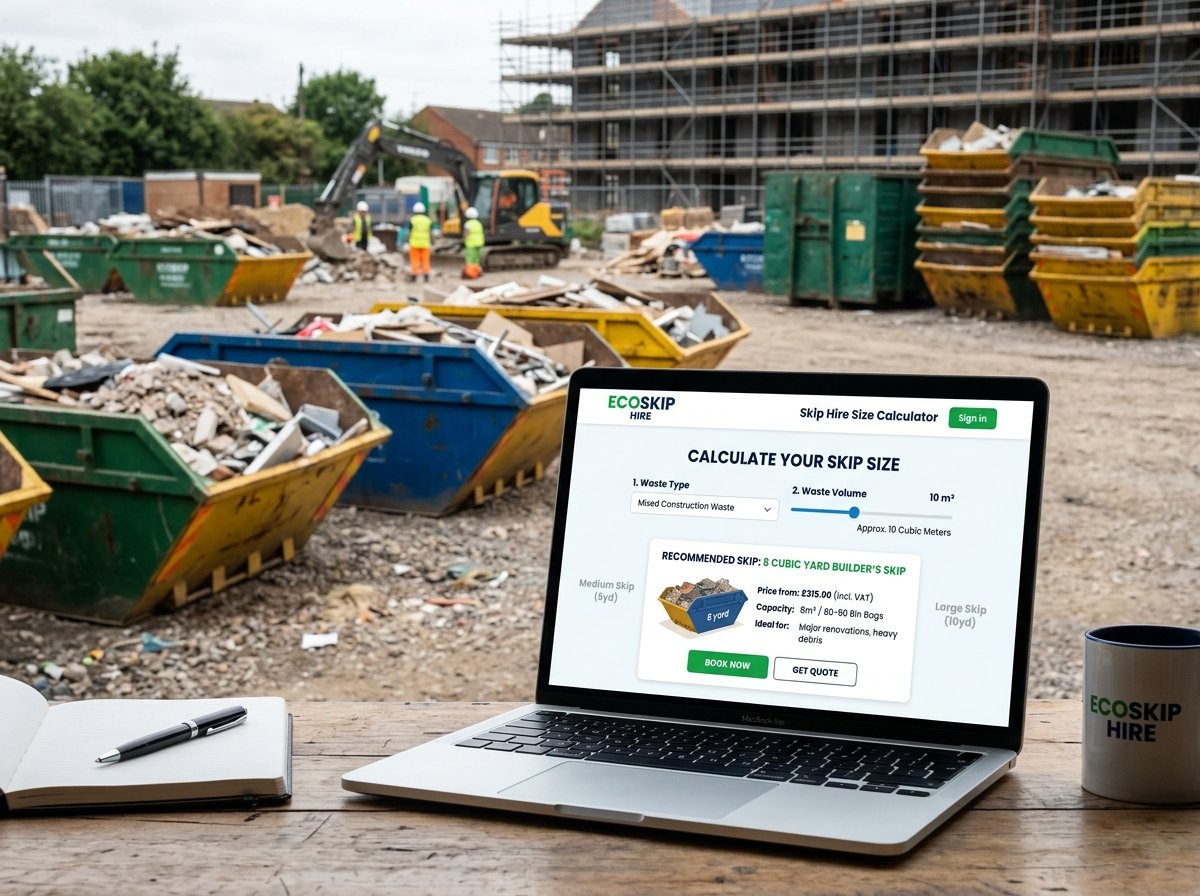
Skip Hire Sizing Calculator: Estimate Skip Sizes, Quantities, and Costs Accurately
Hiring a skip is one of the most common ways to remove waste from a construction, renovation, or garden project. But choosing the wrong skip size can lead to multiple collections, wasted money, or even permit issues. Our Skip Hire Sizing Calculator is a free online tool that helps you determine the right skip size, the number of skips required, and the total cost, including permits, hazardous waste surcharges, and extra hire days.
In this guide, we’ll show you how to use the calculator, explain each cost component, provide real-world examples, and answer common questions. We’ll also share tips to reduce your skip hire costs.
Skip Hire Sizing
Construction CalculatorSkip hire: size, quantity, permits, hazardous waste, collection and cost.
What is the Skip Hire Sizing Calculator?
The Skip Hire Sizing Calculator is a free online tool that calculates the number of skips needed for your waste volume, based on the waste type, bulking factor, skip size, and any regulatory limits. It also estimates the total cost, including skip hire, road permits, hazardous waste surcharges, extra hire days, and lighting/signage. The calculator is part of a suite of earthworks and hauling calculators available on our website. For related calculations, you can use our Muck Away Cost Calculator, Grab Lorry Sizing Calculator, and Tipper Truck Hire Calculator.
How to Use the Skip Hire Sizing Calculator
Using the calculator is straightforward. Here’s a breakdown of each field:
1. Waste
- Waste type: Select the type of waste: General / mixed, Garden waste, Builders / C&D, Heavy (soil, rubble, concrete), Wood only, Green waste, or Hazardous (asbestos, chemicals). Waste type limits the maximum allowed skip size. For example, heavy waste is limited to 8 yd³ skips.
2. Volume
- Volume input: Choose whether to estimate volume from area or enter it directly. Select “Estimate from area” if you know the area and average depth. Select “Direct volume” if you already know the volume in cubic meters.
- Waste area: Enter the area covered by waste in square meters or square feet. Used only when “Estimate from area” is selected.
- Average depth: Enter the average thickness of the waste layer in meters or inches. Used only when “Estimate from area” is selected.
- Direct volume: Enter the volume of waste in cubic meters or cubic yards. Used only when “Direct volume” is selected.
- Bulking factor: Enter the factor that converts in-place volume to loose volume. Loose waste bulks 1.20–1.50 depending on material. The default is 1.30.
3. Skip
- Skip size: Select the skip size: 2 yd³ mini skip, 4 yd³, 6 yd³, 8 yd³, 12 yd³ (max on road without permit), 16 yd³, 20 yd³, or Custom. The effective size is limited by waste type.
- Custom skip volume: If you selected “Custom”, enter the skip volume in cubic yards or cubic meters.
4. Pricing
- Skip hire (incl. collection): Enter the local all-in price per skip, including hire, delivery, and disposal.
5. Permit
- Road permit: Select Off road (no permit), On road, standard permit, or Extended permit (weeks). Off-road skips do not require a permit.
- Permit cost: Enter the local permit cost per skip. Set to 0 if not applicable.
6. Hazardous
- Hazardous handling: Select Yes if the waste requires specialist disposal. Only for hazardous waste types.
- Hazardous surcharge per skip: Enter the local specialist disposal surcharge per skip.
7. Extras
- Extra day charge: Enter the local extra-day rate per skip. Set to 0 if not required.
- Extra hire days: Enter the number of additional days you will keep each skip.
- Lighting / signage: Enter the local cost for lighting or signage, required for on-road skips at night.
Once you enter all values, the calculator instantly displays:
- Waste volume (in place)
- Loose volume
- Skip size used (effective)
- Skips required
- Skip hire and disposal cost
- Road permit cost
- Hazardous surcharge
- Extra hire days cost
- Lighting / signage cost
- Grand total
Understanding the Cost Components
To make the most of the calculator, it’s important to understand each component.
- Waste volume (in place): The volume of waste before bulking. It’s calculated as
area × depthif estimating from area, or taken directly from the direct volume input. - Loose volume: When waste is moved or excavated, it expands. The loose volume is
in-place volume × bulking factor. This is the volume the skip actually holds. - Skip size used: The selected skip size, capped by the maximum allowed for the waste type. For example, heavy waste is limited to 8 yd³, so a 16 yd³ skip would be reduced to 8 yd³.
- Skips required: Calculated as
ceil(loose volume in yd³ / effective skip size in yd³). At least one skip is required if there is any waste. - Skip hire and disposal:
skips × price per skip. This is the all-in cost per skip. - Road permit cost: For on-road skips, a permit is usually required. The calculator multiplies the permit cost by the number of skips. Extended permits cost double the standard rate (multiplier 2×).
- Hazardous surcharge: If hazardous handling is selected, the surcharge per skip is multiplied by the number of skips.
- Extra hire days: If you keep each skip for additional days, the cost is
extra day rate × extra days × number of skips. - Lighting / signage: A flat cost added for on-road skips at night.
- Grand total: The sum of all costs.
Understanding these components helps you choose the right skip size, avoid unexpected fees, and budget accurately. For more information on skip hire, you can refer to Wikipedia’s article on skip (container).
Example Calculations
Let’s run through a few examples to see how the calculator works in different scenarios.
Example 1: Builders Waste, 8 yd³ Skip, Off Road
- Waste type: Builders / C&D
- Volume input: Estimate from area
- Area: 30 m²
- Average depth: 0.15 m
- Bulking factor: 1.30
- Skip size: 8 yd³
- Skip price: $250
- Permit: Off road
- Permit cost: $0
- Hazardous: No
- Extra day charge: $0
- Extra days: 0
- Lighting: $0
Calculations:
- Waste volume: 30 × 0.15 = 4.5 m³
- Loose volume: 4.5 × 1.30 = 5.85 m³
- Loose volume in yd³: 5.85 × 1.30795 = 7.65 yd³
- Max allowed for builders: 16 yd³
- Effective skip size: min(8, 16) = 8 yd³
- Skips required: ceil(7.65 / 8) = 1
- Skip cost: 1 × $250 = $250
- Permit cost: $0
- Hazardous: $0
- Extra days: $0
- Lighting: $0
- Grand total: $250
Example 2: Heavy Waste, 12 yd³ Skip Requested, On Road with Permit and Extra Days
- Waste type: Heavy (soil, rubble, concrete)
- Volume input: Direct volume
- Direct volume: 10 m³
- Bulking factor: 1.40
- Skip size: 12 yd³ (but heavy waste max 8 yd³)
- Skip price: $300
- Permit: On road, standard permit
- Permit cost: $40
- Hazardous: No
- Extra day charge: $20
- Extra days: 2
- Lighting: $50
Calculations:
- Waste volume: 10 m³
- Loose volume: 10 × 1.40 = 14 m³
- Loose volume in yd³: 14 × 1.30795 = 18.31 yd³
- Max allowed for heavy: 8 yd³
- Effective skip size: min(12, 8) = 8 yd³
- Skips required: ceil(18.31 / 8) = 3
- Skip cost: 3 × $300 = $900
- Permit cost: 3 × $40 × 1 = $120
- Hazardous: $0
- Extra days: $20 × 2 × 3 = $120
- Lighting: $50
- Grand total: $1,190
Example 3: Garden Waste, 16 yd³ Skip, On Road with Extended Permit, Hazardous
- Waste type: Garden waste
- Volume input: Estimate from area
- Area: 100 m²
- Average depth: 0.10 m
- Bulking factor: 1.50
- Skip size: 16 yd³
- Skip price: $280
- Permit: Extended permit
- Permit cost: $60
- Hazardous: Yes (surcharge $100 per skip)
- Extra day charge: $0
- Extra days: 0
- Lighting: $0
Calculations:
- Waste volume: 100 × 0.10 = 10 m³
- Loose volume: 10 × 1.50 = 15 m³
- Loose volume in yd³: 15 × 1.30795 = 19.62 yd³
- Max allowed for garden: 16 yd³
- Effective skip size: min(16, 16) = 16 yd³
- Skips required: ceil(19.62 / 16) = 2
- Skip cost: 2 × $280 = $560
- Permit cost: 2 × $60 × 2 = $240 (extended permit multiplier 2)
- Hazardous: 2 × $100 = $200
- Extra days: $0
- Lighting: $0
- Grand total: $1,000
These examples show how different waste types, skip sizes, and permits affect the total cost.
Benefits of Using the Skip Hire Sizing Calculator
Tips for Accurate Skip Hire Sizing
- Measure waste volume accurately: For irregular piles, measure the base area and average height. For excavated material, use the in-place volume from your excavation plans.
- Choose the right bulking factor: Soil and rubble bulk less than garden waste. Typical factors: soil 1.25, rubble 1.40, garden waste 1.50.
- Know the waste type limits: Heavy waste (soil, rubble, concrete) cannot go in large skips due to weight. The calculator caps the skip size automatically.
- Check permit requirements: On-road skips usually require a permit. Off-road skips (on private property) do not. Extended permits cost more.
- Consider hazardous waste: Asbestos, chemicals, and other hazardous materials require specialist disposal and add a surcharge.
- Account for extra days: If you need the skip longer than the standard hire period (usually 1–2 weeks), extra day charges apply per skip.
- Don’t forget lighting: On-road skips at night require lighting or signage. This is often a flat fee but can be per skip.
- Compare with grab lorries: For large volumes, grab lorries may be more cost-effective. Use our Grab Lorry Sizing Calculator to compare.
For more information on waste management, you can refer to resources like Wikipedia’s article on waste management or guidelines from the Environmental Protection Agency.
How to Reduce Skip Hire Costs
If your estimate is higher than expected, here are some ways to reduce costs:
- Separate waste types: Recyclable materials like metal and concrete may be accepted at lower rates or for free.
- Reuse material on site: Use soil for backfilling or landscaping to reduce the volume to be removed.
- Choose the right skip size: Larger skips are more efficient per m³, but only if weight limits allow. Heavy waste requires smaller skips.
- Minimize bulking: Compact or store waste efficiently to reduce loose volume.
- Negotiate rates: For multiple skips, ask for a volume discount.
- Avoid hazardous waste: If possible, separate hazardous materials and dispose of them separately to avoid surcharges.
- Return skips on time: Avoid extra day charges by returning skips promptly.
Frequently Asked Questions (FAQ)
Conclusion
The Skip Hire Sizing Calculator is an essential tool for anyone planning a waste removal project. It helps you choose the right skip size, estimate the number of skips, and budget accurately for hire, permits, surcharges, and extras. By following the tips in this article and using the calculator, you can confidently plan your skip hire. Don’t forget to explore our other hauling calculators for all your sitework needs.
Whether you’re clearing a garden or managing a construction site, accurate skip sizing is key to a successful project. Try the Skip Hire Sizing Calculator today and take the guesswork out of your waste removal budget.






2 Comments