
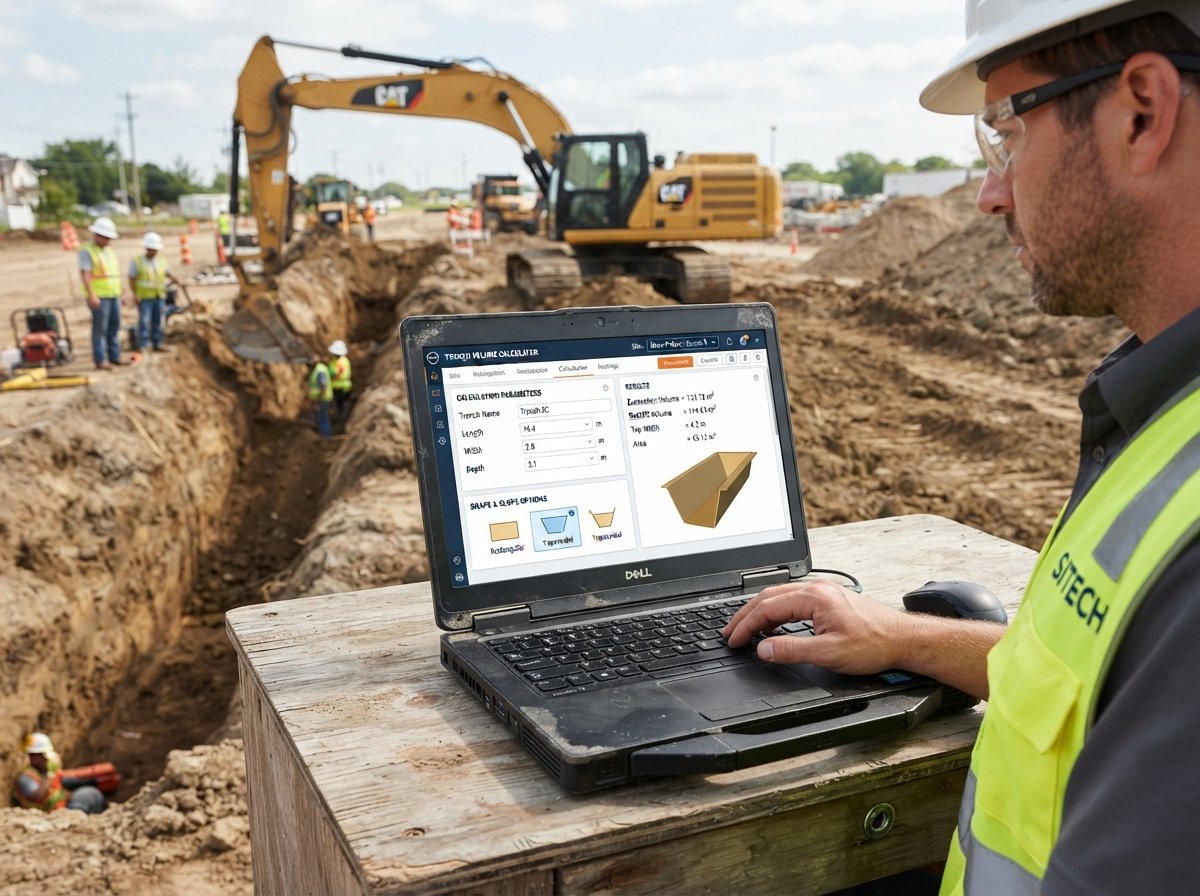
Trench Volume Calculator: Estimate Trench Excavation Volume and Costs Accurately
Trench excavation is a fundamental part of many construction and utility projects. Whether you’re laying pipes, cables, drainage, or building foundations, knowing the volume of material to be excavated is essential for planning, budgeting, and ordering equipment. Our Trench Volume Calculator is a free online tool that helps you calculate the geometric volume, the volume including side slopes, the loose (bulked) volume, and optional excavation costs.
In this guide, we’ll show you how to use the calculator, explain the calculations, provide real-world examples, and answer common questions. We’ll also share tips to improve accuracy and reduce costs.
Trench Volume
Construction CalculatorTrench volume: geometry, side slopes, bulking factor and spoil volume.
What is the Trench Volume Calculator?
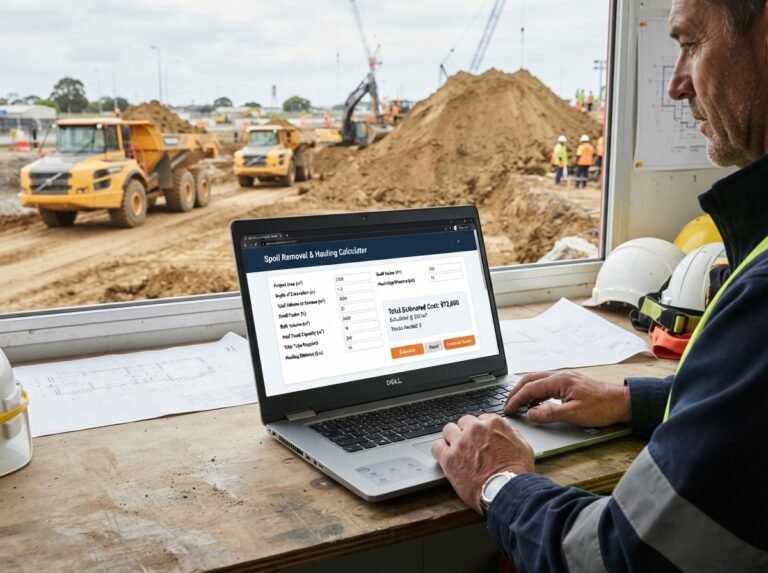
The Trench Volume Calculator is a free online tool that calculates the volume of a trench based on its length, width, depth, side slope configuration, and bulking factor. It provides a clear breakdown of geometric volume, volume including slopes, and loose (bulked) volume. You can also enter an excavation price per m³ to get an estimated excavation cost and contingency. The calculator is part of a suite of earthworks calculators available on our website. For related calculations, you can use our Trench Excavation / Spoil Calculator, Spoil Removal / Hauling Calculator, and Backfill Volume Calculator.
How to Use the Trench Volume Calculator
Using the calculator is straightforward. Here’s a breakdown of each field:
1. Dimensions
- Trench length: Enter the length of the trench in meters or feet.
- Trench width: Enter the width of the trench in meters or inches.
- Trench depth: Enter the depth of the trench in meters or inches.
2. Slopes
- Side slopes: Select the type of side slopes: Vertical sides, Gentle (1:0.5), Moderate (1:1), or Steep (1:1.5). Sloped sides increase the volume of spoil compared to a plain prism. The calculator applies a multiplier: Vertical 1.00, Gentle 1.10, Moderate 1.25, Steep 1.45.
3. Bulking
- Bulking factor: Enter the factor that converts in-place volume to loose volume. Typical values: sand ~1.10, loam ~1.20, clay ~1.30, rock ~1.50. The default is 1.25.
4. Cost
- Excavation price per m³: Enter the local excavation rate. Set to 0 to skip the cost output.
- Contingency: Enter a percentage for unforeseen conditions. Typically 3–8%. The default is 5%.
Once you enter all values, the calculator instantly displays:
- Geometric volume
- Volume including slopes
- Loose (bulked) volume
- Excavation cost (if price > 0)
- Contingency amount
- Grand total (if price > 0)
Understanding the Cost Components
To make the most of the calculator, it’s important to understand each volume component.
- Geometric volume: This is the theoretical volume of the trench assuming vertical sides:
length × width × depth. It represents the in-situ volume without any allowances. - Volume including slopes: When sides are sloped (battered), the excavation volume increases. The calculator multiplies the geometric volume by a slope factor. Vertical sides use 1.00, Gentle slopes (1:0.5) use 1.10, Moderate (1:1) use 1.25, and Steep (1:1.5) use 1.45. This gives the actual in-situ volume to be excavated.
- Loose (bulked) volume: When soil is excavated, it expands (bulks). The bulking factor converts the in-situ volume to loose volume. This is the volume you actually have to handle and haul. Typical factors: sand 1.10, loam 1.20, clay 1.30, rock 1.50.
- Excavation cost: If you enter a price per m³, the calculator computes cost as
volume including slopes × excavation price. Excavation is priced per in-situ cubic meter, not loose volume. - Contingency: A reserve for unexpected costs, such as additional excavation due to soft spots or rock. Typically 3–8%.
Understanding these components helps you plan equipment, manage spoil, and budget accurately. For more information on trenching, you can refer to Wikipedia’s article on trenching.
Example Calculations
Let’s run through a few examples to see how the calculator works in different scenarios.
Example 1: Vertical-Sided Trench in Loam
- Length: 20 m
- Width: 0.6 m
- Depth: 1.2 m
- Side slopes: Vertical (1.00)
- Bulking factor: 1.20
- Excavation price: $25/m³
- Contingency: 5%
Calculations:
- Geometric volume: 20 × 0.6 × 1.2 = 14.4 m³
- Volume including slopes: 14.4 × 1.00 = 14.4 m³
- Loose volume: 14.4 × 1.20 = 17.28 m³
- Excavation cost: 14.4 × $25 = $360
- Contingency: 5% of $360 = $18
- Grand total: $378
Example 2: Moderately Sloped Trench in Clay
- Length: 15 m
- Width: 0.8 m
- Depth: 2.0 m
- Side slopes: Moderate (1:1) → factor 1.25
- Bulking factor: 1.30
- Excavation price: $40/m³
- Contingency: 8%
Calculations:
- Geometric volume: 15 × 0.8 × 2.0 = 24 m³
- Volume including slopes: 24 × 1.25 = 30 m³
- Loose volume: 30 × 1.30 = 39 m³
- Excavation cost: 30 × $40 = $1,200
- Contingency: 8% of $1,200 = $96
- Grand total: $1,296
Example 3: Steeply Sloped Trench in Sand, No Cost Output
- Length: 30 m
- Width: 0.4 m
- Depth: 0.8 m
- Side slopes: Steep (1:1.5) → factor 1.45
- Bulking factor: 1.10
- Excavation price: $0 (skip cost)
- Contingency: 5% (not used)
Calculations:
- Geometric volume: 30 × 0.4 × 0.8 = 9.6 m³
- Volume including slopes: 9.6 × 1.45 = 13.92 m³
- Loose volume: 13.92 × 1.10 = 15.312 m³
- Cost: not shown (price = 0)
These examples show how different dimensions, slopes, and soil types affect the trench volume.
Benefits of Using the Trench Volume Calculator
Tips for Accurate Trench Volume Estimation
- Measure dimensions accurately: Double-check length, width, and depth. For long trenches, consider dividing into sections if the depth varies.
- Choose realistic side slopes: The slope depends on soil type, depth, and safety requirements. Vertical sides require shoring. Gentle slopes are safer but increase volume.
- Use correct bulking factors: Soil type matters. Sand bulks less than clay. If you’re unsure, use 1.25 as a starting point, but adjust based on local experience.
- Consider spoil reuse: If the soil is suitable, reuse it on site to reduce haul-off costs. Test the soil for contaminants and gradation.
- Account for over-excavation: Soft spots, roots, or rock can increase excavation volume. Add a contingency.
- Check local rates: Excavation prices vary widely by region. Contact local contractors for current rates.
- Include dewatering: If the trench is below the water table, you may need dewatering pumps. Add these costs separately.
- Plan for permits: Some trenches require permits, especially near utilities or waterways. Check local regulations.
For more information on trenching safety, you can refer to resources like Wikipedia’s article on trenching or guidelines from the Occupational Safety and Health Administration.
How to Reduce Trench Excavation Costs
If your estimate is higher than expected, here are some ways to reduce costs:
- Optimize trench dimensions: Work with your engineer to minimize width and depth without compromising the design.
- Reuse spoil on site: Increase the percentage of spoil kept on site. This reduces haul-off and disposal costs.
- Schedule efficiently: Combine excavation with other earthworks to reduce machine mobilisation costs.
- Negotiate rates: For large projects, ask for volume discounts.
- Avoid over-excavation: Accurate setting out and careful excavation prevent digging more than necessary.
- Get multiple quotes: Compare at least three contractors. Prices can vary widely.
- Consider trenchless methods: For utility installations, trenchless technology can eliminate excavation entirely.
Frequently Asked Questions (FAQ)
Conclusion
The Trench Volume Calculator is an essential tool for anyone planning a trenching project. It helps you estimate geometric volume, slope allowance, loose volume, and optional excavation costs accurately, so you can order the right equipment, manage spoil, and stay on budget. By following the tips in this article and using the calculator, you can confidently plan your trench excavation.
Whether you’re laying a utility line or building a foundation, accurate trench volume estimation is key to a successful project. Try the Trench Volume Calculator today and take the guesswork out of your earthworks budget.





2 Comments