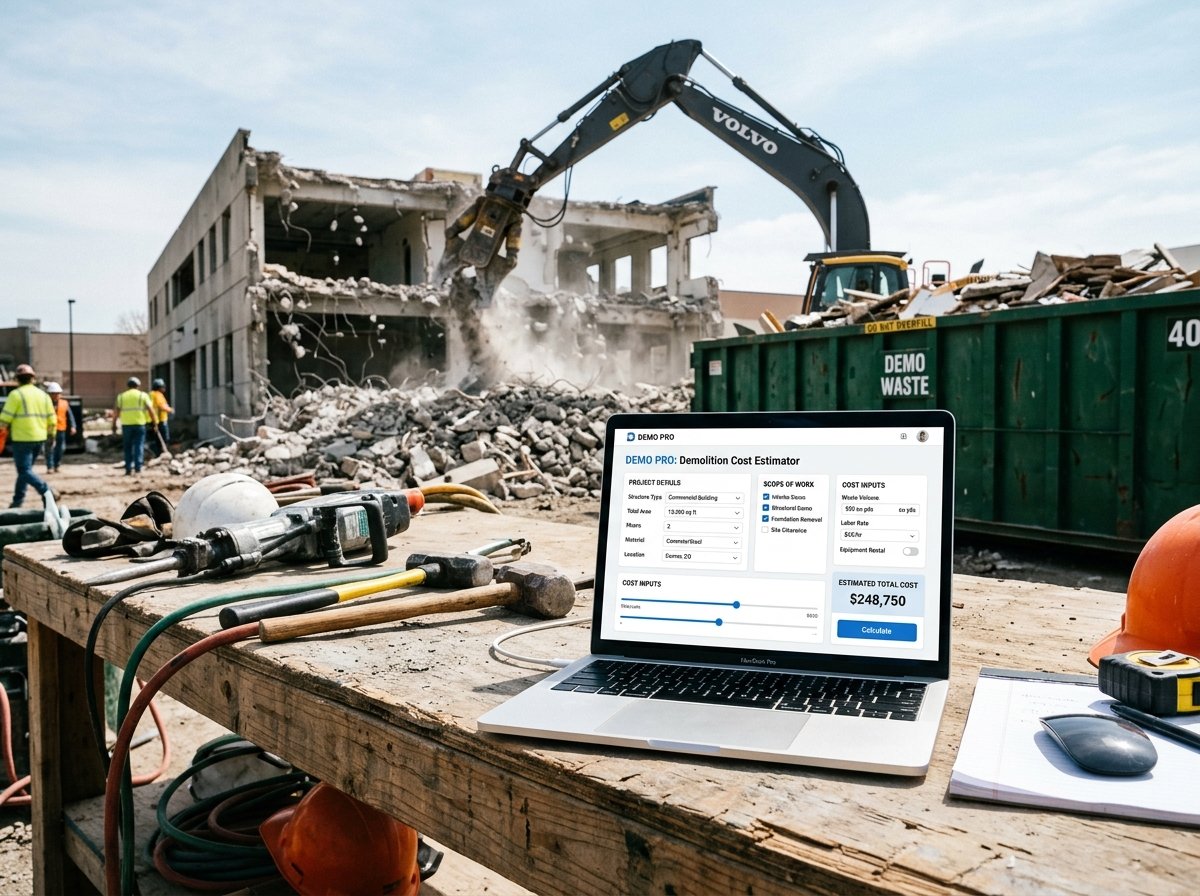
Demolition Cost Calculator: Estimate Your Demolition Project Costs Accurately
Demolition is often the first step in a renovation or new construction project. Whether you’re stripping out an old kitchen, removing interior walls, or tearing down an entire structure, understanding the costs involved is essential for budgeting and planning. Our Demolition Cost Calculator is a free online tool that helps you estimate the total cost of your demolition project, including labour, debris removal, skip hire, and contingency.
In this guide, we’ll show you how to use the calculator, explain each cost component, provide real-world examples, and answer common questions. We’ll also share tips to keep your demolition project on budget and on schedule.
Demolition Cost
Construction CalculatorDemolition project cost: labour, debris volume, skips and contingency.
What is the Demolition Cost Calculator?
The Demolition Cost Calculator is a free online tool that calculates the total cost of a demolition job based on the area to be demolished, the scope of work, site access, floor level, labour rate, debris volume, skip size, and contingency. It provides a clear breakdown of demolition labour, debris volume, skips required, haulage and disposal, contingency, and grand total. The calculator is part of a suite of construction and renovation calculators available on our website. For a complete project budget, you can combine it with our Renovation Cost Estimator, Construction Estimate Calculator, Labour Cost Calculator, and Material Cost Calculator.
How to Use the Demolition Cost Calculator
Using the calculator is straightforward. Here’s a breakdown of each field:
1. Dimensions
- Demolition area: Enter the floor or surface area to be demolished in square meters or square feet. For example, if you’re removing a 50 m² floor, enter 50.
2. Scope
- What is being removed: Select the type of demolition: Interior finishes, Walls / partitions, Floor / screed, Roof, Concrete structures, or Whole house. This applies a difficulty factor to the labour cost. Concrete structures are the most labour-intensive (1.8×), while interior finishes are the least (0.85×).
- Site access: Select Easy (direct vehicle access), Medium (narrow driveway), or Hard (manual carry only). Access affects labour effort. Easy reduces labour by 10%, Hard increases it by 20%.
- Floor level: Enter the floor level above ground. Each level above ground adds approximately 8% to labour costs due to the extra effort of carrying debris downstairs.
3. Labour
- Labour rate per m²: Enter the local combined crew cost per square meter of demolition. This should include wages, supervision, and equipment operation.
4. Debris
- Debris produced per m²: Enter the volume of debris produced per square meter in cubic meters (m³/m²). Typical values range from 0.10 to 0.30 m³/m² depending on the scope. For example, interior finishes produce less debris than concrete structures.
- Skip / container volume: Enter the volume of the skip or container you plan to hire, in cubic meters. Common sizes are 6, 8, and 12 m³. The default is 8 m³.
- Container price: Enter the price per container. This usually includes haulage and disposal.
5. Costs
- Contingency: Enter a percentage for unforeseen conditions. Demolition often reveals hidden issues, so a 5–15% contingency is recommended. The default is 10%.
Once you enter all values, the calculator instantly displays:
- Debris volume
- Skips required
- Demolition labour cost
- Haulage and disposal cost
- Contingency amount
- Grand total
Understanding the Cost Components
To make the most of the calculator, it’s important to understand each cost component and how they interact.
- Demolition labour: This is the cost of the crew performing the demolition. It’s calculated as
area × labour rate × complexity factor. The complexity factor is the product of the scope factor, access factor, and floor level factor. For example, demolishing concrete walls on the third floor with hard access will have a high complexity factor, significantly increasing labour costs. - Debris volume: This is the total volume of debris generated, calculated as
area × debris produced per m². Accurate estimation of debris volume is crucial for determining how many skips you need. - Skips required: This is calculated by dividing the total debris volume by the container volume and rounding up to the nearest whole number. You must hire whole skips, so rounding up ensures you have enough capacity.
- Haulage and disposal: This is the cost of hiring skips and disposing of the debris. It’s calculated as
skips × container price. The container price typically includes delivery, pickup, and disposal fees. - Contingency: This is a reserve for unexpected costs, such as hidden asbestos, unexpected structural issues, or additional debris. It’s calculated as a percentage of the subtotal (labour + disposal).
- Grand total: This is the final estimated cost, including all components.
Understanding these components helps you plan your project, negotiate with contractors, and avoid surprises. For more information on demolition planning, you can refer to Wikipedia’s article on demolition.
Example Calculations
Let’s run through a few examples to see how the calculator works in different scenarios.
Example 1: Interior Strip-Out of a Kitchen
- Area: 20 m²
- Scope: Interior finishes (0.85×)
- Access: Easy (0.90×)
- Floor level: 1 (no extra)
- Labour rate: $30/m²
- Debris per m²: 0.15 m³/m²
- Container volume: 6 m³
- Container price: $250
- Contingency: 10%
Calculations:
- Complexity factor: 0.85 × 0.90 × 1.0 = 0.765
- Labour cost: 20 × $30 × 0.765 = $459
- Debris volume: 20 × 0.15 = 3 m³
- Skips required: ceil(3 / 6) = 1
- Disposal cost: 1 × $250 = $250
- Subtotal: $459 + $250 = $709
- Contingency: 10% of $709 = $70.90
- Grand total: $779.90
Example 2: Removal of Concrete Floor on Third Floor
- Area: 50 m²
- Scope: Concrete structures (1.80×)
- Access: Hard (1.20×)
- Floor level: 3 (adds 16% → factor 1 + (3-1)×0.08 = 1.16)
- Labour rate: $50/m²
- Debris per m²: 0.30 m³/m²
- Container volume: 8 m³
- Container price: $400
- Contingency: 15%
Calculations:
- Complexity factor: 1.80 × 1.20 × 1.16 = 2.5056
- Labour cost: 50 × $50 × 2.5056 = $6,264
- Debris volume: 50 × 0.30 = 15 m³
- Skips required: ceil(15 / 8) = 2
- Disposal cost: 2 × $400 = $800
- Subtotal: $6,264 + $800 = $7,064
- Contingency: 15% of $7,064 = $1,059.60
- Grand total: $8,123.60
Example 3: Full House Demolition
- Area: 120 m²
- Scope: Whole house (1.50×)
- Access: Medium (1.00×)
- Floor level: 1 (no extra)
- Labour rate: $40/m²
- Debris per m²: 0.25 m³/m²
- Container volume: 12 m³
- Container price: $500
- Contingency: 12%
Calculations:
- Complexity factor: 1.50 × 1.00 × 1.00 = 1.50
- Labour cost: 120 × $40 × 1.50 = $7,200
- Debris volume: 120 × 0.25 = 30 m³
- Skips required: ceil(30 / 12) = 3
- Disposal cost: 3 × $500 = $1,500
- Subtotal: $7,200 + $1,500 = $8,700
- Contingency: 12% of $8,700 = $1,044
- Grand total: $9,744
These examples show how different scopes, access conditions, and floor levels affect the total demolition cost.
Benefits of Using the Demolition Cost Calculator
Tips for Accurate Demolition Cost Estimation
- Survey the site carefully: Identify what is being demolished, including hidden structures, utilities, and hazardous materials like asbestos.
- Choose the right scope: Be realistic about the difficulty. Concrete and structural demolition are much more expensive than interior strip-outs.
- Assess access accurately: Narrow driveways, stairs, and long carries increase labour time. Don’t underestimate access challenges.
- Estimate debris volume realistically: Debris volume depends on the material and how it breaks up. Use historical data or consult a contractor.
- Select the right skip size: Larger skips are more cost-effective per cubic meter, but you need space for delivery and placement.
- Include contingency: Demolition always reveals surprises. A 10–15% contingency is standard, but older buildings may need 20%.
- Check for permits and regulations: Demolition may require permits, asbestos surveys, and utility disconnections. Add these costs separately.
- Consider recycling: Some materials can be recycled, reducing disposal costs. Check local recycling facilities.
For more information on demolition safety and regulations, you can refer to resources like Wikipedia’s article on demolition or guidelines from the National Demolition Association.
How to Reduce Demolition Costs
If your estimate is higher than expected, here are some ways to reduce costs without compromising safety:
- Do some demolition yourself: Removing non-structural elements like cabinets, flooring, and trim can be done by a handy homeowner.
- Sort and recycle: Separate recyclable materials like metal, concrete, and wood. Recycling can reduce disposal fees.
- Choose the right skip size: Optimize skip size to avoid paying for unused capacity.
- Schedule efficiently: Combine demolition with other site work to reduce mobilisation costs.
- Get multiple quotes: Compare at least three contractors. Prices can vary widely.
- Avoid peak season: Contractors may offer lower rates during slower months.
- Consider deconstruction: Salvaging materials for reuse can offset costs and reduce waste.
Frequently Asked Questions (FAQ)
Conclusion
The Demolition Cost Calculator is an essential tool for anyone planning a demolition project. It helps you budget accurately, compare scenarios, and avoid surprises. By following the tips in this article and using the calculator, you can confidently estimate your demolition costs. Don’t forget to explore our other calculators for all your construction and renovation needs.
Whether you’re stripping out a single room or demolishing an entire building, accurate cost estimation is key to a successful project. Try the Demolition Cost Calculator today and take the guesswork out of your budget.