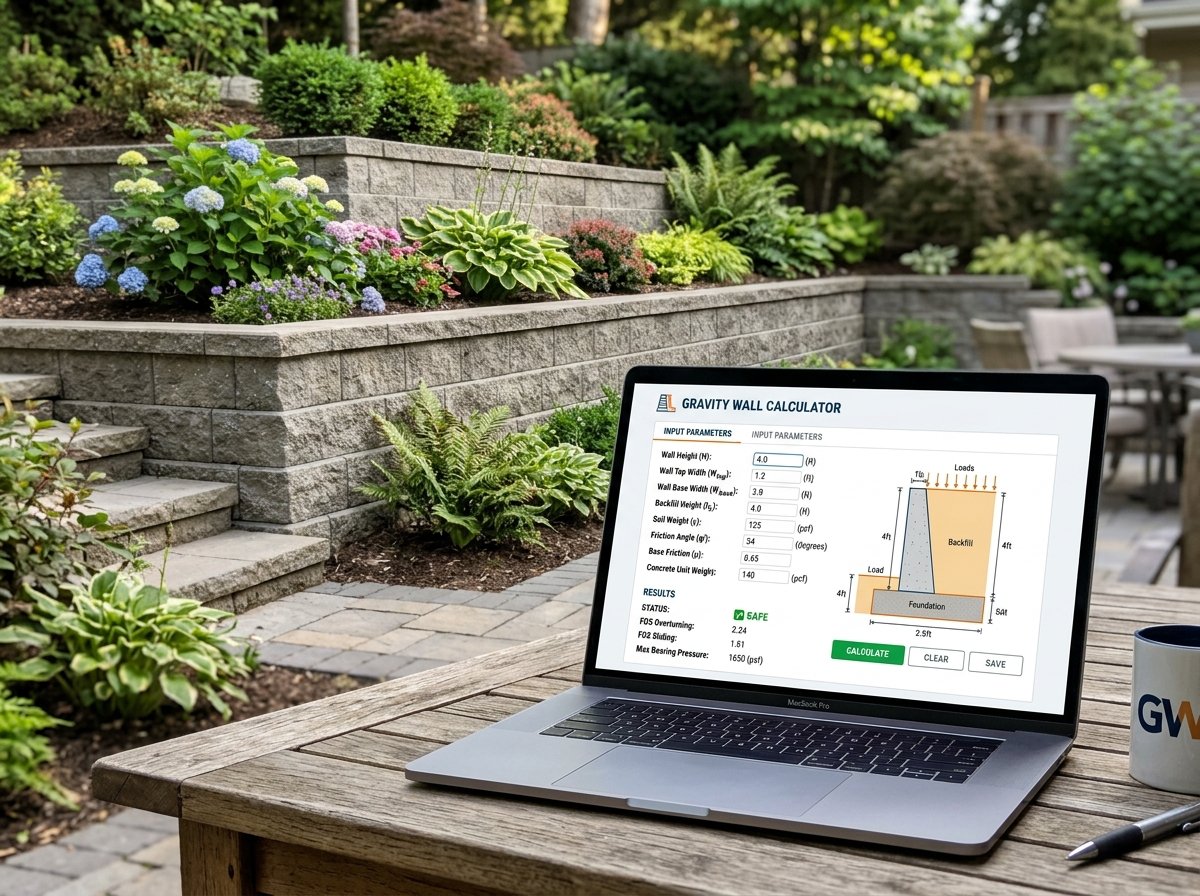
Gravity Retaining Wall Calculator: Estimate Blocks, Concrete, and Costs
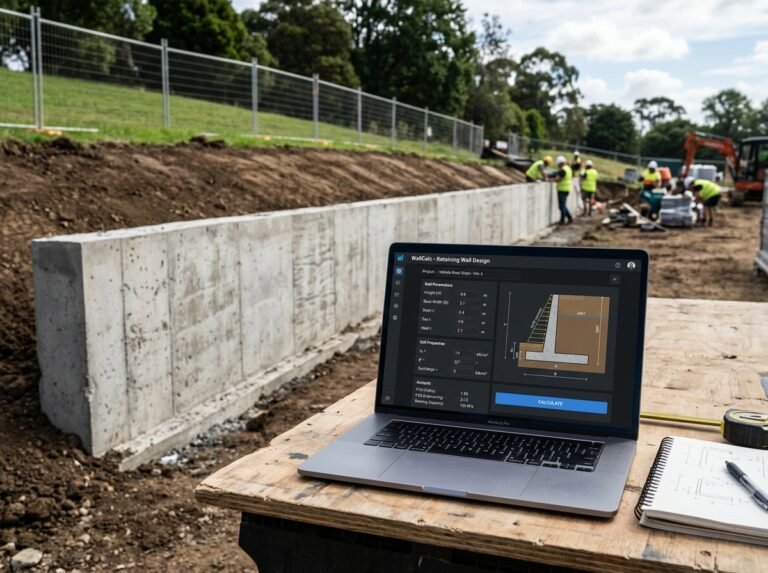
Gravity retaining walls are among the oldest and most reliable structures for holding back soil. They rely on their own weight to resist the lateral pressure of the retained earth. Whether you’re building a garden wall, a driveway edge, or a small agricultural terrace, getting the materials and costs right is essential. An undersized wall can bulge or collapse; an oversized wall wastes concrete, blocks, and labour. Our Gravity Retaining Wall Calculator is a free online tool that helps you estimate the wall face area, body volume, foundation volume, drainage requirements, and total installed cost based on your wall dimensions, soil conditions, and chosen materials.
In this guide, we’ll show you how to use the calculator, explain the calculations, provide real-world examples, and answer common questions. We’ll also share tips to ensure your gravity retaining wall is safe, durable, and cost-effective.
Gravity Retaining Wall
Construction CalculatorGravity retaining wall: blocks, concrete, drainage, backfill and cost.
What is the Gravity Retaining Wall Calculator?
The Gravity Retaining Wall Calculator is a free online tool that calculates the material quantities and costs for a gravity retaining wall. It supports common wall types (concrete block, brick, natural stone, poured concrete, timber sleeper) and soil conditions (free-draining, clay, surcharged). The calculator accounts for wall length, retained height, base width, wall thickness, foundation depth and width, drainage provision, and local pricing for wall face, concrete, gravel, perforated pipe, and labour. It provides a clear breakdown of wall face area, wall body volume, effective base width, foundation volume, drainage gravel volume, and costs for each component. The tool is part of a suite of structural and foundation calculators available on our website. For related calculations, you can use our Raft Foundation Calculator, Pile Capacity Calculator, and Trench Fill Foundation Calculator. If you’re designing a reinforced concrete retaining wall, our Retaining Wall Design Calculator provides stability checks.
How to Use the Gravity Retaining Wall Calculator
Using the calculator is straightforward. Here’s a breakdown of each field:
1. Wall
- Wall length: Enter the total length of the wall in meters or feet.
- Retained height: Enter the height of soil being retained in meters or feet. This is the height from the finished ground level at the front to the top of the wall.
- Wall type: Select the wall material: Concrete block (gravity), Brick, Natural stone, Poured concrete, or Timber sleeper. This applies a materials and labour multiplier to the wall face cost.
2. Soil & dimensions
- Backfill soil: Select the soil type: Free-draining (gravel / sand), Clay / cohesive, or Surcharged (driveway / building behind). This affects the required base width multiplier.
- Base width: Enter the base width in meters or inches. Typically 0.4–0.6 × retained height. For example, a 1.2 m high wall might have a 0.45 m base.
- Wall thickness at top: Enter the thickness of the wall at the top in meters or inches. For example, 0.20 m = 200 mm. This is used for the wall body volume reference.
3. Foundation
- Foundation depth: Enter the depth of the foundation below ground in meters or inches. For example, 0.30 m = 300 mm.
- Foundation width: Enter the width of the foundation in meters or inches. Typically 0.6–0.8 × base width.
4. Drainage
- Drainage: Select Yes (perforated pipe + gravel) or No. Drainage is essential for retaining walls—it prevents hydrostatic pressure build-up behind the wall.
- Drainage gravel per metre: Enter the volume of gravel behind the wall per metre of wall length in m³/m. The default is 0.05 m³/m.
5. Costs
- Concrete per m³: Enter the local price per cubic meter of concrete for the foundation. Leave 0 to skip.
- Gravel per m³: Enter the local price per cubic meter of drainage gravel. Leave 0 to skip.
- Perforated pipe per metre: Enter the local price per metre of perforated pipe. Leave 0 to skip.
- Wall price per m²: Enter the local price per square meter of wall face (blocks + mortar, bricks, stone, etc.). Leave 0 to skip.
- Labour per m²: Enter the local labour cost per square meter of wall face. Leave 0 to skip.
Once you enter all values, the calculator instantly displays:
- Wall face area (m²)
- Wall body volume (m³)
- Effective base width (mm)
- Foundation volume (m³)
- Drainage gravel volume (m³) – if applicable
- Wall face cost, foundation cost, drainage cost, labour cost, and grand total (if prices entered)
Understanding the Cost Components
To make the most of the calculator, it’s important to understand each output and the underlying formulas.
- Wall face area:
length × retained height. This is the visible area of the wall that needs to be faced with blocks, bricks, or stone. - Wall body volume: The volume of the wall itself, assuming a trapezoidal cross-section. The average thickness is
(effective base width + top thickness) / 2. The volume iswall face area × average thickness. This is useful for estimating concrete if you’re pouring the wall, or for understanding the bulk of the structure. - Effective base width: The base width you enter multiplied by a soil factor: free-draining 1.0, clay 1.2, surcharged 1.4. This accounts for the increased overturning resistance required for cohesive or surcharged soils.
- Foundation volume:
length × foundation width × foundation depth. This is the volume of concrete for the foundation. - Drainage gravel volume: If drainage is selected,
length × gravel per metre. This is the volume of gravel placed behind the wall to allow water to drain freely. - Wall cost:
wall face area × wall price per m² × wall type multiplier. The multiplier adjusts for the relative cost of different materials: block 1.00, brick 1.35, stone 1.80, concrete 1.20, timber 0.70. - Foundation cost:
foundation volume × concrete price per m³. - Drainage cost:
drainage gravel volume × gravel price+wall length × perforated pipe price. - Labour cost:
wall face area × labour price per m² × wall type multiplier. The multiplier reflects the labour intensity of different materials. - Grand total: Sum of all costs.
Understanding these components helps you interpret the results and adjust your design. For more information on retaining walls, you can refer to Wikipedia’s article on retaining walls.
Example Calculations
Let’s run through a few examples to see how the calculator works in different scenarios.
Example 1: Concrete Block Wall, 8 m Long, 1.2 m High, Free-Draining Soil
- Wall length: 8 m
- Retained height: 1.2 m
- Wall type: Concrete block (multiplier 1.00)
- Backfill soil: Free-draining (multiplier 1.00)
- Base width: 0.45 m
- Wall thickness at top: 0.20 m
- Foundation depth: 0.30 m
- Foundation width: 0.60 m
- Drainage: Yes
- Drainage gravel per metre: 0.05 m³/m
- Concrete price: $120/m³
- Gravel price: $40/m³
- Pipe price: $8/m
- Wall price: $60/m²
- Labour price: $40/m²
Calculations:
- Wall face area = 8 × 1.2 = 9.6 m²
- Effective base width = 0.45 × 1.00 = 0.45 m
- Average thickness = (0.45 + 0.20) / 2 = 0.325 m
- Wall body volume = 9.6 × 0.325 = 3.12 m³
- Foundation volume = 8 × 0.60 × 0.30 = 1.44 m³
- Drainage gravel volume = 8 × 0.05 = 0.40 m³
- Wall cost = 9.6 × $60 × 1.00 = $576
- Foundation cost = 1.44 × $120 = $172.80
- Drainage cost = 0.40 × $40 + 8 × $8 = $16 + $64 = $80
- Labour cost = 9.6 × $40 × 1.00 = $384
- Total = $576 + $172.80 + $80 + $384 = $1,212.80
- Result: Total cost $1,212.80
Example 2: Natural Stone Wall, 12 m Long, 1.8 m High, Clay Soil
- Wall length: 12 m
- Retained height: 1.8 m
- Wall type: Natural stone (multiplier 1.80)
- Backfill soil: Clay (multiplier 1.20)
- Base width: 0.90 m (0.5 × height)
- Wall thickness at top: 0.30 m
- Foundation depth: 0.40 m
- Foundation width: 1.20 m
- Drainage: Yes
- Drainage gravel per metre: 0.08 m³/m
- Concrete price: $130/m³
- Gravel price: $45/m³
- Pipe price: $10/m
- Wall price: $120/m²
- Labour price: $70/m²
Calculations:
- Wall face area = 12 × 1.8 = 21.6 m²
- Effective base width = 0.90 × 1.20 = 1.08 m
- Average thickness = (1.08 + 0.30) / 2 = 0.69 m
- Wall body volume = 21.6 × 0.69 = 14.904 m³
- Foundation volume = 12 × 1.20 × 0.40 = 5.76 m³
- Drainage gravel volume = 12 × 0.08 = 0.96 m³
- Wall cost = 21.6 × $120 × 1.80 = $4,665.60
- Foundation cost = 5.76 × $130 = $748.80
- Drainage cost = 0.96 × $45 + 12 × $10 = $43.20 + $120 = $163.20
- Labour cost = 21.6 × $70 × 1.80 = $2,721.60
- Total = $4,665.60 + $748.80 + $163.20 + $2,721.60 = $8,299.20
- Result: Total cost $8,299.20
Example 3: Timber Sleeper Wall, 6 m Long, 0.9 m High, Surcharged Soil
- Wall length: 6 m
- Retained height: 0.9 m
- Wall type: Timber sleeper (multiplier 0.70)
- Backfill soil: Surcharged (multiplier 1.40)
- Base width: 0.45 m
- Wall thickness at top: 0.15 m
- Foundation depth: 0.30 m
- Foundation width: 0.60 m
- Drainage: Yes
- Drainage gravel per metre: 0.04 m³/m
- Concrete price: $115/m³
- Gravel price: $38/m³
- Pipe price: $7/m
- Wall price: $85/m²
- Labour price: $45/m²
Calculations:
- Wall face area = 6 × 0.9 = 5.4 m²
- Effective base width = 0.45 × 1.40 = 0.63 m
- Average thickness = (0.63 + 0.15) / 2 = 0.39 m
- Wall body volume = 5.4 × 0.39 = 2.106 m³
- Foundation volume = 6 × 0.60 × 0.30 = 1.08 m³
- Drainage gravel volume = 6 × 0.04 = 0.24 m³
- Wall cost = 5.4 × $85 × 0.70 = $321.30
- Foundation cost = 1.08 × $115 = $124.20
- Drainage cost = 0.24 × $38 + 6 × $7 = $9.12 + $42 = $51.12
- Labour cost = 5.4 × $45 × 0.70 = $170.10
- Total = $321.30 + $124.20 + $51.12 + $170.10 = $666.72
- Result: Total cost $666.72
These examples show how different wall types, soil conditions, and dimensions affect the total cost.
Benefits of Using the Gravity Retaining Wall Calculator
Tips for Accurate Gravity Retaining Wall Estimation
- Measure the wall length and retained height accurately: Double-check dimensions. The retained height is the height of soil behind the wall, not the total wall height above ground.
- Choose the correct wall type: Different materials have different costs and labour requirements. The multiplier accounts for this.
- Assess the soil conditions: Clay and surcharged soils require a wider base for stability. The calculator adjusts the effective base width automatically.
- Provide adequate drainage: Water pressure is the most common cause of retaining wall failure. Always include a perforated pipe and gravel backfill. The calculator includes this if you select “Yes”.
- Use the correct base width: Typically 0.4–0.6 × retained height for gravity walls. For clay or surcharge, increase accordingly.
- Don’t forget the foundation: The foundation must be below the frost line and wide enough to spread the load. The calculator computes the concrete volume.
- Include labour: Labour can be a significant portion of the cost. Enter a realistic rate for your area.
- Verify with a professional: For walls over 1.5 m high or on sloping ground, have a structural engineer check the design.
For more information on retaining wall design, you can refer to resources like Wikipedia’s article on retaining walls or guidelines from the Institution of Structural Engineers.
How to Reduce Gravity Retaining Wall Costs
If your estimate is higher than expected, here are ways to reduce costs without compromising safety:
- Choose a simpler wall type: Timber sleeper walls are often cheaper than stone or brick.
- Optimize the base width: Work with an engineer to find the minimum safe base width for your soil.
- Reduce the retained height: Lower walls require less material and smaller foundations.
- Use free-draining backfill: This reduces the required base width and avoids hydrostatic pressure.
- Install drainage yourself: If you’re handy, you can save on labour by installing the perforated pipe and gravel.
- Buy materials in bulk: Negotiate discounts for blocks, concrete, and gravel.
- Get multiple quotes: Compare suppliers and contractors for the best price.
Frequently Asked Questions (FAQ)
Conclusion
The Gravity Retaining Wall Calculator is an essential tool for builders, landscapers, and DIY enthusiasts. It helps you estimate the materials and costs for a block, brick, stone, concrete, or timber retaining wall. By following the tips in this article and using the calculator, you can confidently plan your retaining wall project. Don’t forget to explore our other foundation and structural calculators for all your construction needs.
Whether you’re terracing a garden or holding back a driveway, accurate retaining wall estimation is key to a safe and successful project. Try the Gravity Retaining Wall Calculator today and take the guesswork out of your retaining wall budget.