
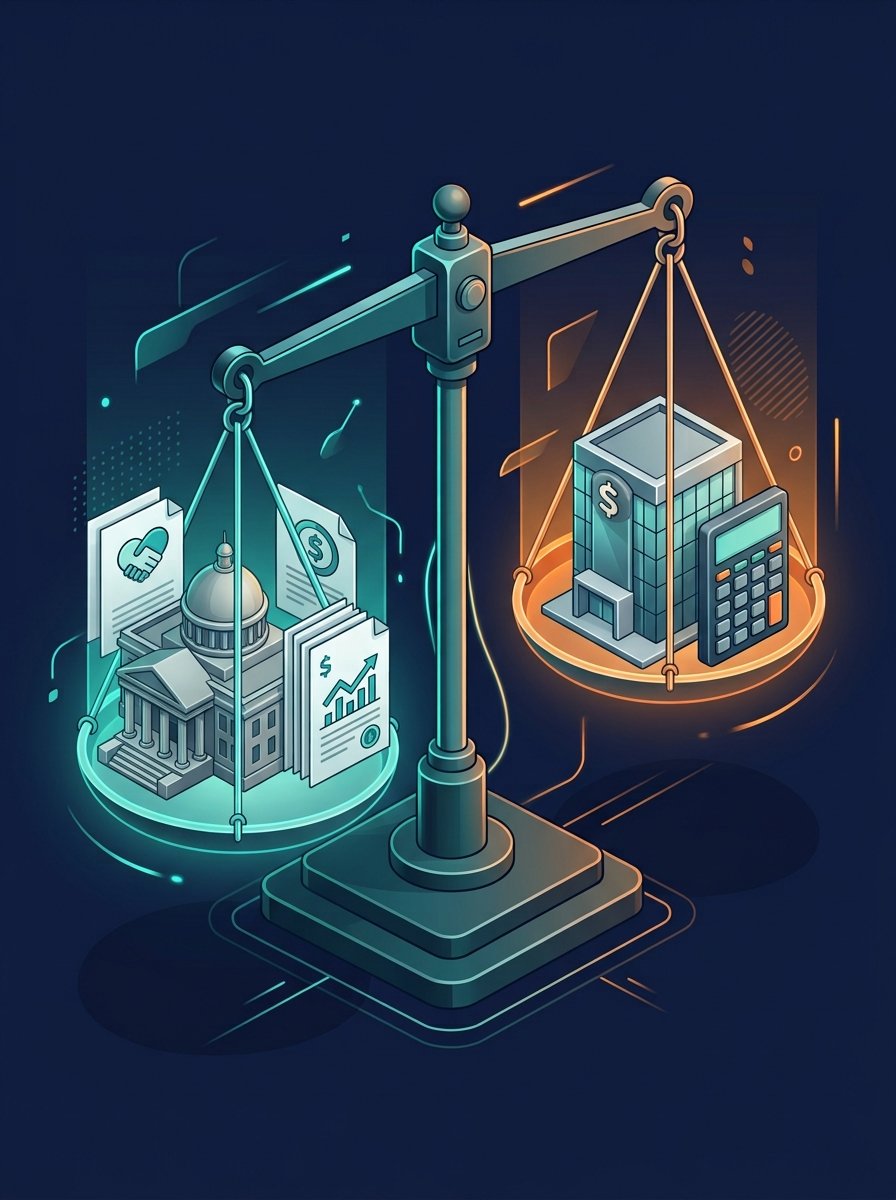
Federal vs Private Loans for Student: The Ultimate Comparison Guide
Choosing between federal and private student loans is one of the most consequential financial decisions you’ll make as a student. Federal loans offer flexible repayment plans, forgiveness options, and deferment, but they often have higher interest rates. Private loans come with lower rates for borrowers with excellent credit, but they lack the safety net of federal programs. Our advanced Federal vs Private Loan Comparison Calculator cuts through the noise. It not only compares the basic monthly payment and total interest but also factors in complex variables like Income-Driven Repayment (IDR), Public Service Loan Forgiveness (PSLF), forbearance periods, origination fees, and tax deductions. This gives you the true, apples-to-apples cost of each option, allowing you to make a confident decision about your education financing.
Federal vs. Private Loan Comparison
The Fundamental Differences
Before diving into the calculator, it’s essential to understand the core differences:
- Federal Loans: Backed by the US Department of Education. They offer fixed rates, income-based repayment, loan forgiveness for public servants (PSLF), and deferment/forbearance options. They do not require a credit check for most loans (unless you’re a graduate student taking out PLUS loans).
- Private Loans: Offered by banks, credit unions, and online lenders. They often provide lower interest rates to borrowers with high credit scores and a co-signer. However, they generally have fewer consumer protections, no forgiveness programs, and stricter repayment terms.
How Our Calculator Works
Our tool simulates the life of both loans based on your inputs:
- Loan Amount & Term: The total amount you need to borrow and the repayment period (usually 10 years).
- Interest Rates: You input both the federal and private rates. If you are unsure, check current rates on StudentAid.gov for federal loans and NerdWallet for private rates.
- Private Origination Fee: Many private lenders charge an upfront fee (1-5% of the loan), which adds to your total cost.
- Forbearance/Deferment Months: We replaced the vague “likelihood” with a precise number. If you expect to have periods where you cannot make payments (e.g., during a job transition), enter the number of months. The calculator capitalizes the interest accrued during this time, adding it to your total cost.
- PSLF Eligibility: If you work in public service and have made qualifying payments for a few years, check this box.
- Income-Driven Repayment (IDR): If you select this, the calculator calculates your payment based on 10% of your discretionary income (above 150% of the poverty line) and simulates a forgiveness period of 20 years (or 10 years for PSLF).
- Tax Deduction: The Student Loan Interest Deduction allows you to deduct up to $2,500 of interest paid. We factor in your marginal tax rate to show your net savings.
The Power of Income-Driven Repayment (IDR)
Federal loans offer IDR plans that cap your monthly payment at a percentage of your discretionary income. After 20 or 25 years of qualifying payments, the remaining balance is forgiven. This is a massive benefit for borrowers with low starting salaries. Our calculator uses the standard PAYE formula (10% of income above 150% of the poverty line). If your income is low, your IDR payments could be significantly lower than the standard payment, but the total interest accrued could be higher due to the longer repayment window. Our tool accurately models this trade-off, showing you the total amount you’ll actually pay and the potential forgiven balance.
The PSLF Advantage
Public Service Loan Forgiveness (PSLF) is available to employees of government and non-profit organizations who make 120 qualifying payments (10 years) while on an IDR plan. The remaining balance is then forgiven tax-free. If you are eligible, this can completely change the math. Our calculator subtracts the years you’ve already completed and simulates the remaining 120-month period. If your balance is still positive after 120 months, we add a “Potential Federal Forgiveness” line to your results, which can be tens of thousands of dollars. This makes federal loans vastly superior for career public servants. The official PSLF rules can be found on Federal Student Aid’s PSLF page.
The Hidden Cost of Forbearance
Private loans typically do not offer forbearance—or if they do, interest continues to capitalize, making your debt grow rapidly. Federal loans also capitalize interest during forbearance, but they offer more generous deferment options. Our calculator now lets you specify the exact number of months you expect to be in forbearance. This allows you to see the “snowball” effect of unpaid interest on your total cost. For example, if you have $30,000 at 5.5% and take a 12-month forbearance, you’ll owe an additional $1,650 in capitalized interest, making the loan more expensive.
Tax Deductions – The Silver Lining
Both federal and private student loan interest are eligible for the federal Student Loan Interest Deduction (up to $2,500), but only if your income is below a certain threshold. We include this in the calculator. By subtracting your tax savings from the total cost, we give you a true “net cost” of each loan. This is the number you should focus on when making a decision.
Real-World Example: A $30,000 Loan
Let’s walk through a typical scenario.
- Loan Amount: $30,000, Term: 10 years.
- Federal Rate: 5.5% (fixed).
- Private Rate: 4.5% (variable).
- Income: $50,000, Family Size: 1.
- You are not eligible for PSLF, but you expect 6 months of forbearance.
Federal Loan Result:
- Standard Monthly: $325.65
- Standard Total: $39,078
- Forbearance Impact: Adds ~$800 in capitalized interest.
- Tax Deduction: ~$500 (22% bracket).
- Net Federal Cost: ~$39,378.
Private Loan Result:
- Monthly: $310.85
- Total: $37,302
- Forbearance Impact: Adds ~$670 in capitalized interest.
- Tax Deduction: ~$480.
- Net Private Cost: ~$37,492.
In this case, Private is slightly cheaper by ~$1,886. However, if you are eligible for PSLF, the federal loan would be overwhelmingly better because your forgiven balance could be $20,000+.
How to Choose the Right Loan
- If you plan to work in public service: Choose federal. The PSLF benefit is priceless.
- If you have high credit and a co-signer: Private may save you money on interest, but only if you don’t need forbearance.
- If your income is low or variable: Federal loans offer IDR, which can protect you during rough patches.
- If you want the lowest monthly payment: Federal IDR or extended private terms can help, but you’ll pay more in interest over time.
Your Next Steps: Related Tools
Deciding between loan types is just the beginning. Use these tools to plan your full repayment:
- Student Loan Payoff Calculator
- Student Loan Refinance Comparison
- Graduate School ROI Calculator
- Net Worth Calculator







2 Comments